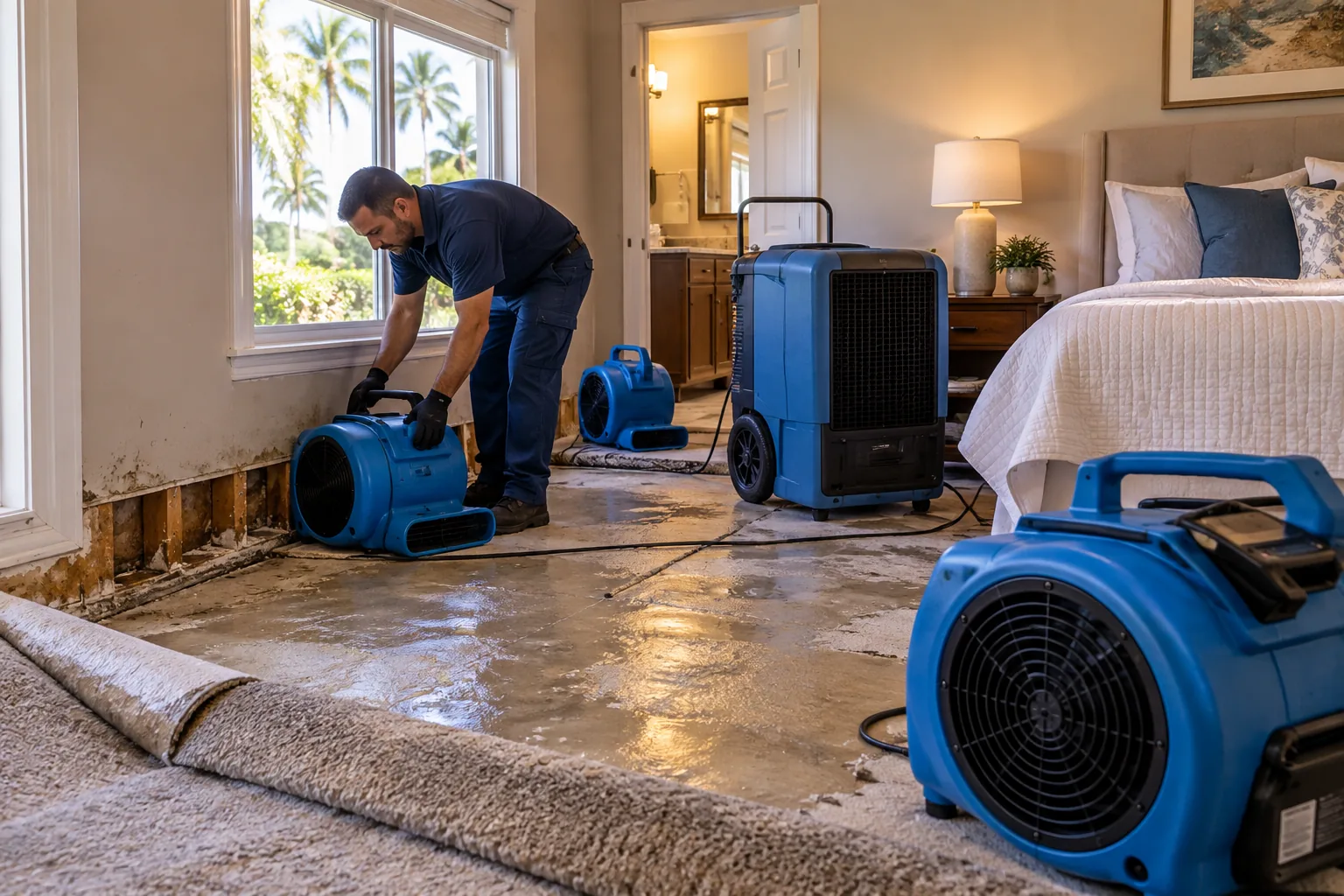
Mold Remediation in Florida
Moisture-related mold cleanup and remediation planning following water intrusion.
Coverage entries describe the service-area directory and do not represent a physical office at every listed ZIP.
Common situations connected to mold remediation
This page explains the service in plain language, connects it to related restoration work and provides a path to the city-level service pages where that coverage exists.
Visible Mold
The response should follow the source, material condition, access and safety considerations.
Moisture-Related Growth
The response should follow the source, material condition, access and safety considerations.
Post-Leak Mold
The response should follow the source, material condition, access and safety considerations.
Containment
The response should follow the source, material condition, access and safety considerations.
Affected Materials
The response should follow the source, material condition, access and safety considerations.
Source Moisture
The response should follow the source, material condition, access and safety considerations.
Use the supporting service to solve the actual problem, not just the visible symptom.
Moisture-related mold cleanup and remediation planning following water intrusion. A useful work plan considers what caused the condition, which materials are affected, what needs to be protected, and what documentation is needed before the next stage.
A practical mold remediation workflow
Initial call and scope review
The work scope should be based on verified conditions and the requirements of the property.
Safety and access assessment
The work scope should be based on verified conditions and the requirements of the property.
Service-specific work
The work scope should be based on verified conditions and the requirements of the property.
Documentation and progress checks
The work scope should be based on verified conditions and the requirements of the property.
Related restoration review
The work scope should be based on verified conditions and the requirements of the property.
Next-step planning
The work scope should be based on verified conditions and the requirements of the property.
How mold remediation can connect to broader restoration
Water Damage Restoration
Water extraction, cleanup, moisture assessment, structural drying and restoration planning for homes and businesses.
Fire Damage Restoration
Fire, smoke and soot cleanup with property stabilization, contents coordination, odor control and restoration planning.
Storm Damage Restoration
Storm and hurricane damage response for roof intrusion, wind damage, flooding, debris and temporary property protection.
Biohazard Cleanup
Professional biohazard cleanup, containment, decontamination and sanitation for sensitive property situations.
What Affects Mold Remediation Cost in Florida?
Professional mold remediation in Florida typically costs $1,500 to $6,000 for contained residential projects — roughly $10–$30 per square foot of affected area. Small contained jobs run less; whole-house or HVAC-involved remediation runs more.
Containment size
A contained bathroom corner vs. whole-house remediation with multi-zone containment — labor, materials, and HEPA runtime scale with the contained area.
Moisture source repair
Remediation without fixing the source fails. The plumbing, roofing, or HVAC repair that caused the mold is a separate — necessary — cost.
Material removal vs. cleaning
Non-porous surfaces can be HEPA-vacuumed and treated. Porous materials (drywall, insulation, carpet) with heavy growth are removed — demolition and rebuild add cost.
HVAC involvement
Mold in ductwork, coils, or the air handler adds NADCA-aligned HVAC cleaning to the scope — otherwise the system re-seeds the home.
How Mold Remediation Works, Step by Step
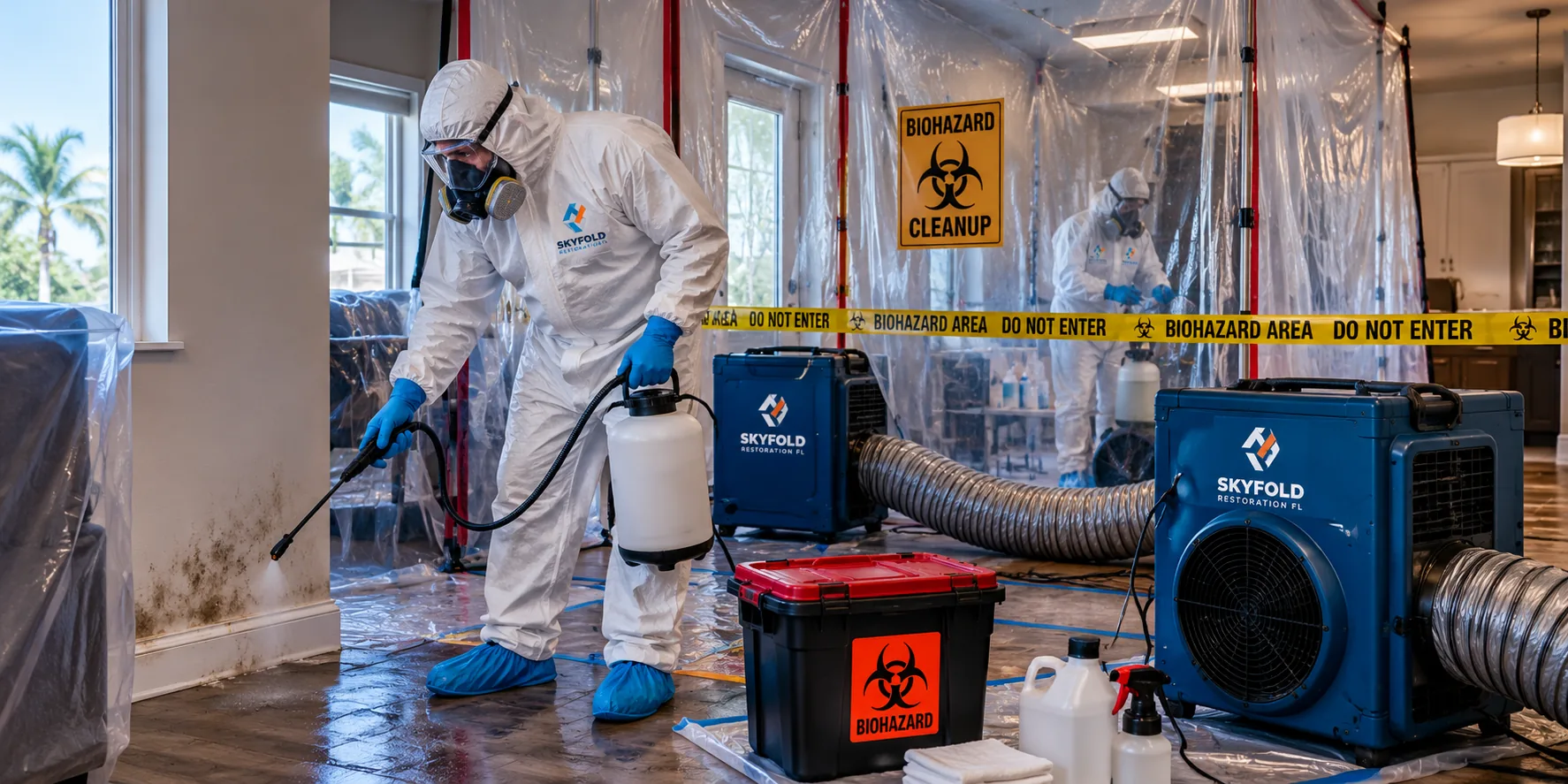
Professional mold remediation follows the ANSI/IICRC S520 standard: fix the moisture, contain the work area, filter the air, remove the growth — then verify.
1. Moisture source identification
The water source feeding the mold is found and fixed first — remediation without this step is guaranteed to fail. Meters and thermal imaging trace hidden moisture.
2. Containment under negative pressure
The work area is sealed with polyethylene barriers and held under negative air pressure with HEPA-filtered negative air machines — spores can’t escape into clean areas.
3. HEPA air filtration
HEPA air scrubbers run continuously, capturing airborne spores down to 0.3 microns. In Florida’s spore-rich air, filtration protects both workers and the rest of the home.
4. Removal & cleaning
Porous materials with heavy growth are removed and bagged. Non-porous surfaces are HEPA-vacuumed, damp-wiped, and treated with EPA-registered antimicrobials.
5. Clearance verification (PRV)
Post-remediation verification — visual inspection plus air/surface sampling compared to outdoor baselines — confirms the job is done. In Florida, the assessor who verifies must be independent from the remediator.
Mold Remediation in Florida: The Law Is Specific Here
Florida regulates mold work more strictly than most states. Under Florida law, a licensed mold assessor (MRSA) and licensed mold remediator (MRSR) must be separate — the same company can’t test and remediate the same job over 10 square feet. Both licenses come from the DBPR. Any Florida mold company offering to ‘test and treat’ in one visit is waving a red flag.
Florida’s climate is the other half: year-round humidity above 60%, AC systems running constantly (condensate leaks are the #1 mold driver), slab-on-grade moisture wicking, and storm intrusion. Remediation here always includes a humidity-control plan — dehumidification, AC maintenance, drainage — or the mold returns with the next wet season.
Emergency
Active mold remediation in Florida? Call (833) 606-6010 now — fast response limits secondary damage.
Mold Remediation questions
When is mold remediation needed?
The answer depends on the loss, affected materials and current site conditions. A property-specific assessment is more reliable than a one-size-fits-all checklist.
What does mold remediation involve?
Moisture-related mold cleanup and remediation planning following water intrusion. The exact scope should follow the actual property conditions.
How does mold remediation connect to other restoration work?
Supporting services are often connected to a broader loss. For example, water extraction may lead into structural drying, while storm damage may lead into tarping and interior water mitigation.
What’s the difference between mold removal and mold remediation?
Removal suggests eliminating all mold — impossible, since mold spores exist everywhere. Remediation means returning mold to normal background levels: fixing the moisture source, containing and removing the growth, filtering the air, and verifying clearance. It’s the professional standard (IICRC S520).
How much does mold remediation cost in Florida?
Typically $1,500–$6,000 for contained residential projects, or $10–$30 per square foot. Whole-house or HVAC-involved jobs cost more. The moisture-source repair is separate.
Does Florida require a licensed mold remediator?
Yes — Florida DBPR licenses mold assessors (MRSA) and remediators (MRSR) separately, and the same company can’t do both on the same job over 10 sq ft. Always verify licenses.
Is mold remediation covered by insurance?
Only if the mold resulted from a covered peril (like a burst pipe) — and Florida policies commonly cap mold coverage ($10,000 is typical). Mold from long-term leaks or humidity usually isn’t covered.
How long does mold remediation take?
Small contained jobs: 1–2 days. Typical residential remediation: 2–5 days including containment setup, clearance testing, and results. Whole-house: 1–2 weeks.
Can mold come back after remediation?
If the moisture source wasn’t fixed or indoor humidity stays high — yes. Proper remediation includes the moisture fix and a humidity-control plan. That’s why the source repair isn’t optional.
Related Restoration Services
Damage rarely involves just one trade. These services commonly connect to mold remediation projects.