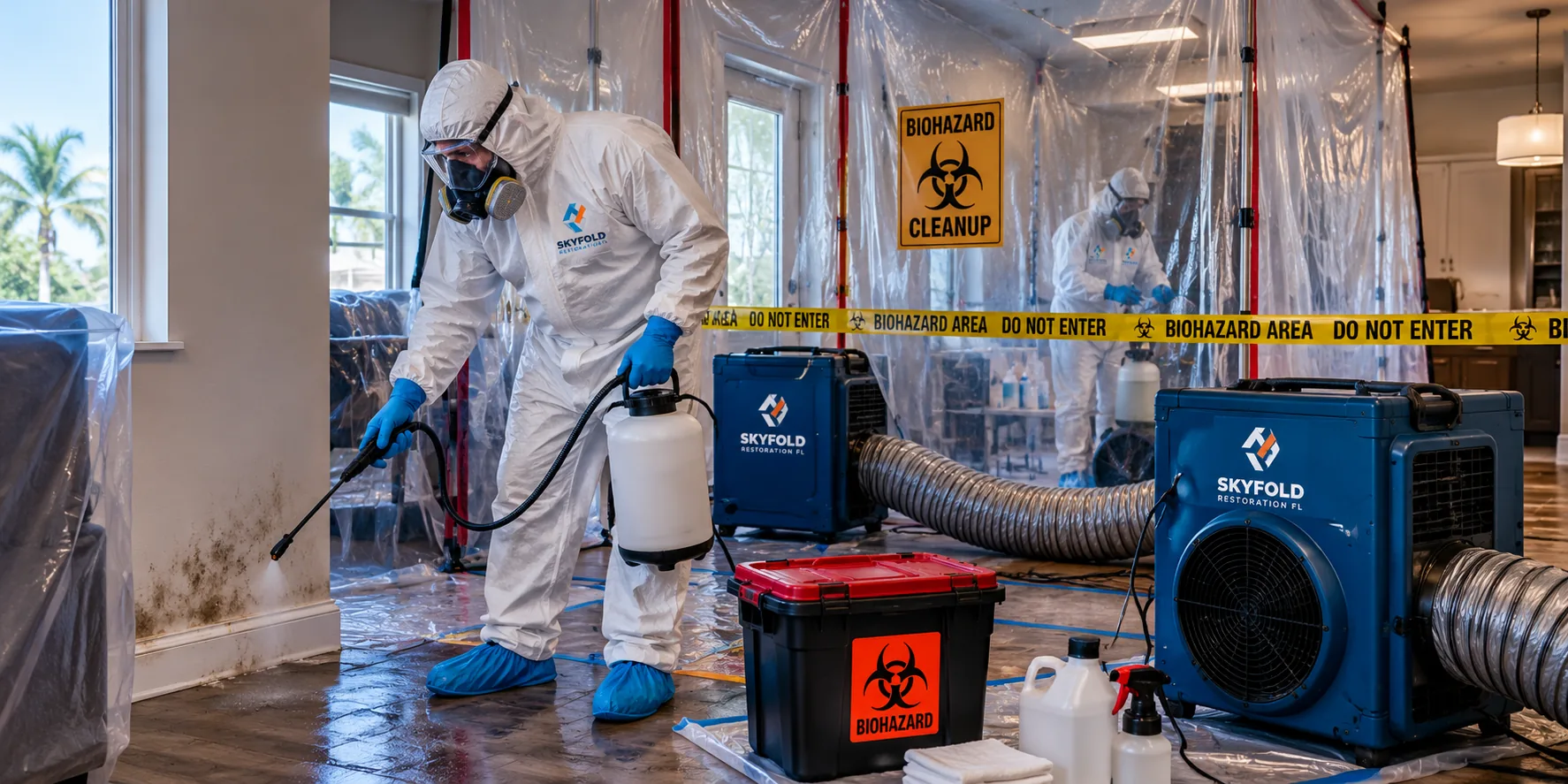
Mold After Water Damage in Florida
When moisture persists after a leak, mold concerns can become part of the restoration conversation. The moisture source still needs to be addressed.
Coverage entries describe the service-area directory and do not represent a physical office at every listed ZIP.
Moisture control comes first
Visible water removal and thorough drying reduce the conditions mold needs to grow. If mold is suspected or visible, avoid unnecessary disturbance and focus on controlling the moisture source.
When mold becomes a related concern
Persistent dampness
An area that stays wet after cleanup deserves closer assessment.
Musty odors
Odors can indicate ongoing moisture or other conditions.
Hidden wet materials
Wall cavities, flooring and insulation may retain moisture.
Repeated leaks
Recurring moisture creates an ongoing risk even after one cleanup.
Water restoration and mold remediation are related but not identical
Water restoration focuses on the water event and drying. Mold remediation focuses on contamination control, removal and cleanup. When the two overlap, the moisture source and affected materials should be evaluated together.
Related restoration services
Water Damage Restoration
Explore the related water damage restoration service and how it connects to the restoration process.
Water Extraction & Removal
Explore the related water extraction & removal service and how it connects to the restoration process.
Structural Drying
Explore the related structural drying service and how it connects to the restoration process.
Flood Damage Cleanup
Explore the related flood damage cleanup service and how it connects to the restoration process.
Insurance Documentation Support
Explore the related insurance documentation support service and how it connects to the restoration process.
Need to talk through a property loss?
Give the city, ZIP code and damage type when you call. For immediate life-safety emergencies, contact 911 first.
Signs Mold Is Growing After Your Leak
Spotting these early is the difference between a quick mitigation and a major restoration. If you see any of them, call (833) 606-6010.
Musty, earthy odor that won’t leave
The #1 indicator. If the room smells musty days after the leak was ‘cleaned up,’ mold is growing somewhere you can’t see — usually inside the wall or under flooring.
Discoloration spreading from the leak area
Black, green, or gray speckling creeping outward from where water was means the colony is expanding behind the paint.
Allergy symptoms indoors
Sneezing, itchy eyes, or congestion that improves when you leave the house is a classic hidden-mold pattern — especially after a leak.
Paint bubbling or wallpaper peeling
Moisture trapped behind finishes feeds mold while loosening adhesion. Either symptom means the wall assembly is still wet.
The leak area never quite dried
If it still feels cool or damp to the touch days later, meters would confirm what touch suggests: moisture remains, and mold is using it.
Mold After Water Leak Questions
How soon does mold grow after a water leak in Florida?
Within 24 to 48 hours in Florida’s humidity. A leak discovered after a weekend is often already growing mold inside cavities.
Can you just dry it and skip mold remediation?
If drying starts within 24–48 hours and meters confirm no growth, sometimes. Once visible growth or musty odor appears, drying alone won’t remove established colonies — remediation per IICRC S520 is needed.
What are signs of mold after a leak?
Musty odors, discoloration on walls or ceilings, allergy-like symptoms that improve away from home, and — the classic — a leak that ‘smells wrong’ days after drying.
Does insurance cover mold after a water leak?
If the leak was a covered sudden event, usually yes — subject to Florida’s common mold coverage caps. Long-term leak mold is typically excluded.
What Affects Mold After Water Leak Cost in Florida?
Mold remediation after a water leak in Florida typically costs $1,500 to $7,500 combined with the drying scope. The leak repair and water mitigation come first; mold adds containment, HEPA filtration, material removal, and clearance testing on top.
Leak duration
A leak caught in days needs drying. One that ran for weeks needs drying plus mold remediation — the mold scope often exceeds the water scope.
Hidden growth
Leaks inside walls and under flooring grow mold invisibly. Opening cavities to find it adds demolition and rebuild to the project.
Water category
Clean-water leaks grow mold; gray/black-water leaks grow mold plus require contamination protocols — more PPE, more removal, more cost.
Clearance testing
Post-remediation verification sampling by an independent assessor is standard in Florida — budget for the assessment alongside the remediation.
How Mold After Water Leak Works, Step by Step
Post-leak mold work is two jobs in sequence: finish the water job properly, then remediate the mold per IICRC S520.
1. Stop the leak & extract
The plumbing, roofing, or appliance source is repaired; standing water is extracted. No mold work starts while water is still entering.
2. Moisture mapping
Meters and thermal imaging find everywhere the leak traveled — including inside cavities where mold is already growing unseen.
3. Drying
Structural drying per IICRC S500 brings materials toward dry standard. Drying alone doesn’t kill established mold — but it stops new growth.
4. Mold remediation under containment
Affected areas are contained under negative pressure; HEPA filtration runs; contaminated porous materials are removed; remaining surfaces are treated.
5. Verification
Independent post-remediation verification (visual + sampling) confirms clearance before rebuild begins.
Mold After Water Leaks: Florida’s 48-Hour Rule
In Florida, the leak-to-mold timeline is brutally short: 24 to 48 hours in humid conditions. That means a Friday-night supply-line leak discovered Monday morning is already a mold job, not just a drying job. Slow leaks — AC condensate lines, pinhole pipe leaks, shower pan failures — are worse: they feed mold for weeks before anyone notices.
Florida insurance reality: if the leak was sudden and accidental, both the water mitigation and resulting mold are typically covered (subject to mold caps). If the leak was long-term seepage, neither may be. The documentation that distinguishes them — photos, moisture logs, plumber’s report on the failure mode — is gathered in the first 48 hours or not at all.
Emergency
Active mold after water leak in Florida? Call (833) 606-6010 now — fast response limits secondary damage.
Related Restoration Services
Damage rarely involves just one trade. These services commonly connect to mold after water leak projects.