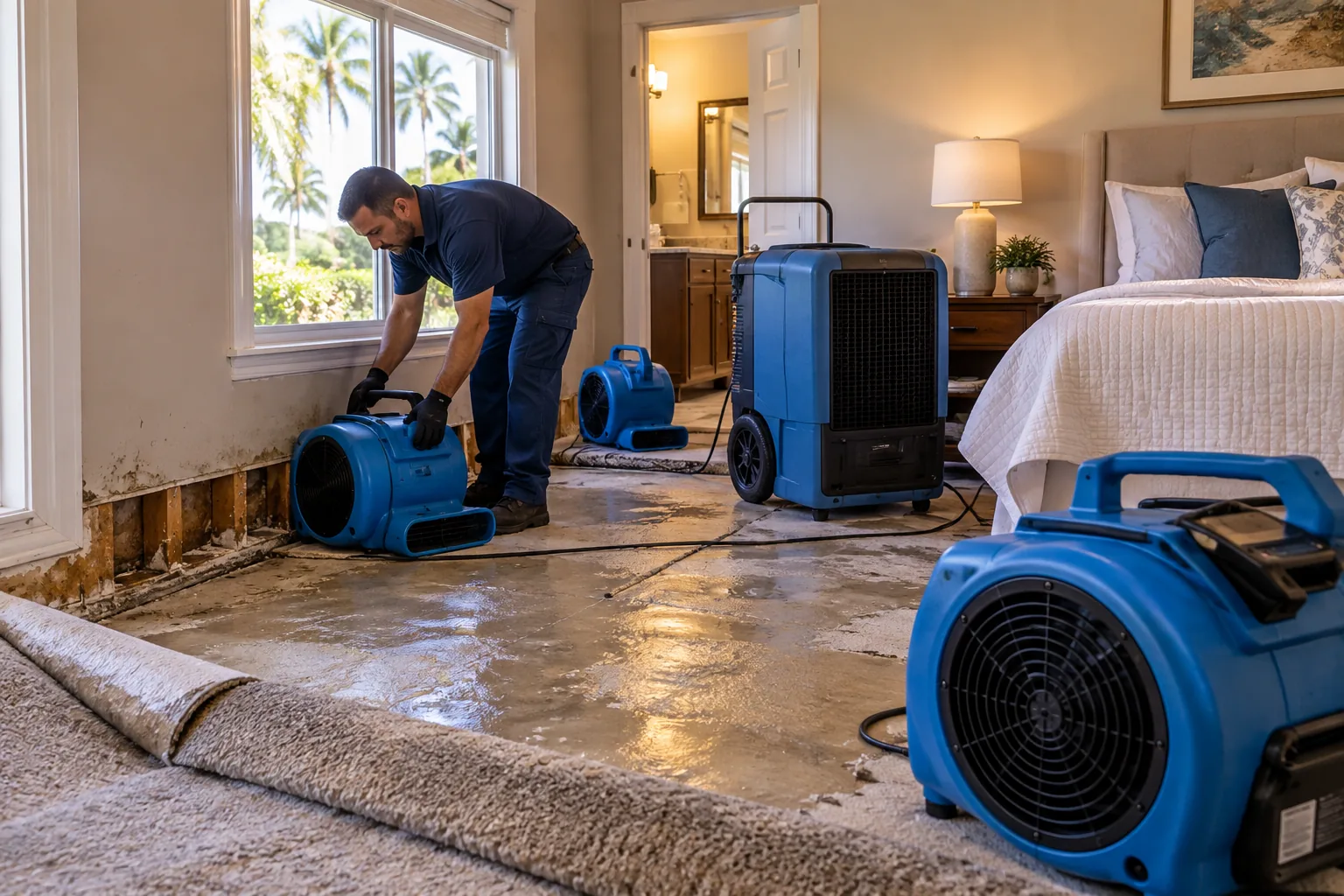
Structural Drying in Florida
Moisture-focused drying for walls, flooring, cabinets, ceilings and structural areas.
Coverage entries describe the service-area directory and do not represent a physical office at every listed ZIP.
Common situations connected to structural drying
This page explains the service in plain language, connects it to related restoration work and provides a path to the city-level service pages where that coverage exists.
Wet Drywall
The response should follow the source, material condition, access and safety considerations.
Wet Flooring
The response should follow the source, material condition, access and safety considerations.
Wet Cabinets
The response should follow the source, material condition, access and safety considerations.
Insulation Moisture
The response should follow the source, material condition, access and safety considerations.
Hidden Cavities
The response should follow the source, material condition, access and safety considerations.
Elevated Indoor Humidity
The response should follow the source, material condition, access and safety considerations.

Use the supporting service to solve the actual problem, not just the visible symptom.
Moisture-focused drying for walls, flooring, cabinets, ceilings and structural areas. A useful work plan considers what caused the condition, which materials are affected, what needs to be protected, and what documentation is needed before the next stage.
A practical structural drying workflow
Initial call and scope review
The work scope should be based on verified conditions and the requirements of the property.
Safety and access assessment
The work scope should be based on verified conditions and the requirements of the property.
Service-specific work
The work scope should be based on verified conditions and the requirements of the property.
Documentation and progress checks
The work scope should be based on verified conditions and the requirements of the property.
Related restoration review
The work scope should be based on verified conditions and the requirements of the property.
Next-step planning
The work scope should be based on verified conditions and the requirements of the property.
How structural drying can connect to broader restoration
Water Damage Restoration
Water extraction, cleanup, moisture assessment, structural drying and restoration planning for homes and businesses.
Fire Damage Restoration
Fire, smoke and soot cleanup with property stabilization, contents coordination, odor control and restoration planning.
Storm Damage Restoration
Storm and hurricane damage response for roof intrusion, wind damage, flooding, debris and temporary property protection.
Biohazard Cleanup
Professional biohazard cleanup, containment, decontamination and sanitation for sensitive property situations.
What Affects Structural Drying Cost in Florida?
Professional structural drying in Florida typically costs $800 to $3,500 as a standalone service, or forms the core of a $1,300–$5,600 water restoration scope. Equipment rental days, affected square footage, and material density drive the number.
Equipment days
Drying equipment rents by the day. A 3-day dry-out costs far less than a 10-day one — which is why fast extraction and correct equipment sizing save money.
Material density
Drywall and carpet dry fast. Hardwood, plaster, concrete, and dense framing hold moisture longer and need more equipment-days.
Affected square footage
More wet area means more air movers and dehumidifiers running simultaneously — costs scale roughly linearly with area.
Hidden moisture
Water behind walls or under flooring that wasn’t mapped early extends drying time. Good moisture mapping on day one prevents week-two surprises.
How Structural Drying Works, Step by Step
Structural drying is applied psychrometry — controlling temperature, humidity, and airflow to pull moisture out of building materials, verified by instruments.
1. Moisture mapping & dry standard
Every wet material is metered. A dry standard is set from unaffected materials in the same building — drying targets that number, not a guess.
2. Equipment sizing
Dehumidifier capacity (pints/day) and air mover count are calculated from the cubic footage and class of water loss per IICRC S500 — not eyeballed.
3. Controlled drying environment
LGR or desiccant dehumidifiers pull moisture from the air while high-velocity air movers sweep it off wet surfaces. In Florida’s humidity, the space is often contained to keep outdoor moisture out.
4. Daily monitoring & drying logs
Technicians re-meter materials daily, reposition equipment, and log readings. The drying log is also claim evidence — it proves the work was necessary and effective.
5. Verification to dry standard
Equipment comes out only when meters confirm materials reached the dry standard. Surface-dry isn’t dry — verification is by instrument.
Structural Drying in Florida’s Humidity: The Hard Part
Florida is one of the hardest states to dry structures in. Outdoor air routinely sits above 70% relative humidity, so opening windows — the instinct in drier climates — actively sabotages drying here. Professional drying in Florida means closed, contained, dehumidified environments.
Slab-on-grade construction, concrete block walls, and tile-over-slab assemblies — standard Florida building — hold moisture in ways wood-frame northern homes don’t. Concrete can take weeks to release deep moisture, and stucco over block can trap water behind it. Drying plans here must account for the actual building science, not a generic formula.
Emergency
Active structural drying in Florida? Call (833) 606-6010 now — fast response limits secondary damage.
Structural Drying questions
When is structural drying needed?
The answer depends on the loss, affected materials and current site conditions. A property-specific assessment is more reliable than a one-size-fits-all checklist.
What does structural drying involve?
Moisture-focused drying for walls, flooring, cabinets, ceilings and structural areas. The exact scope should follow the actual property conditions.
How does structural drying connect to other restoration work?
Supporting services are often connected to a broader loss. For example, water extraction may lead into structural drying, while storm damage may lead into tarping and interior water mitigation.
How long does structural drying take?
Most residential losses reach dry standard in 3 to 5 days of active drying. Dense materials (hardwood, concrete, plaster) or hidden moisture can extend it to 7–14 days.
Can I dry water damage with fans and open windows?
In Florida, no — open windows admit humid outdoor air that stalls drying and feeds mold. Household fans can’t move enough air or remove moisture from it. Professional dehumidification is what actually dries materials.
What is a dry standard?
The moisture content of unaffected materials in the same building, measured with meters. Drying is complete when wet materials return to that baseline — an objective, documented endpoint.
What are LGR dehumidifiers?
Low-grain refrigerant dehumidifiers — commercial units that pull far more moisture per day than residential models and keep working in the low-humidity conditions that develop late in the drying process.
How is drying progress documented?
Through drying logs: daily moisture readings, equipment readings, temperature and humidity data. These logs prove to insurers that the drying was necessary, properly executed, and complete.
Related Restoration Services
Damage rarely involves just one trade. These services commonly connect to structural drying projects.