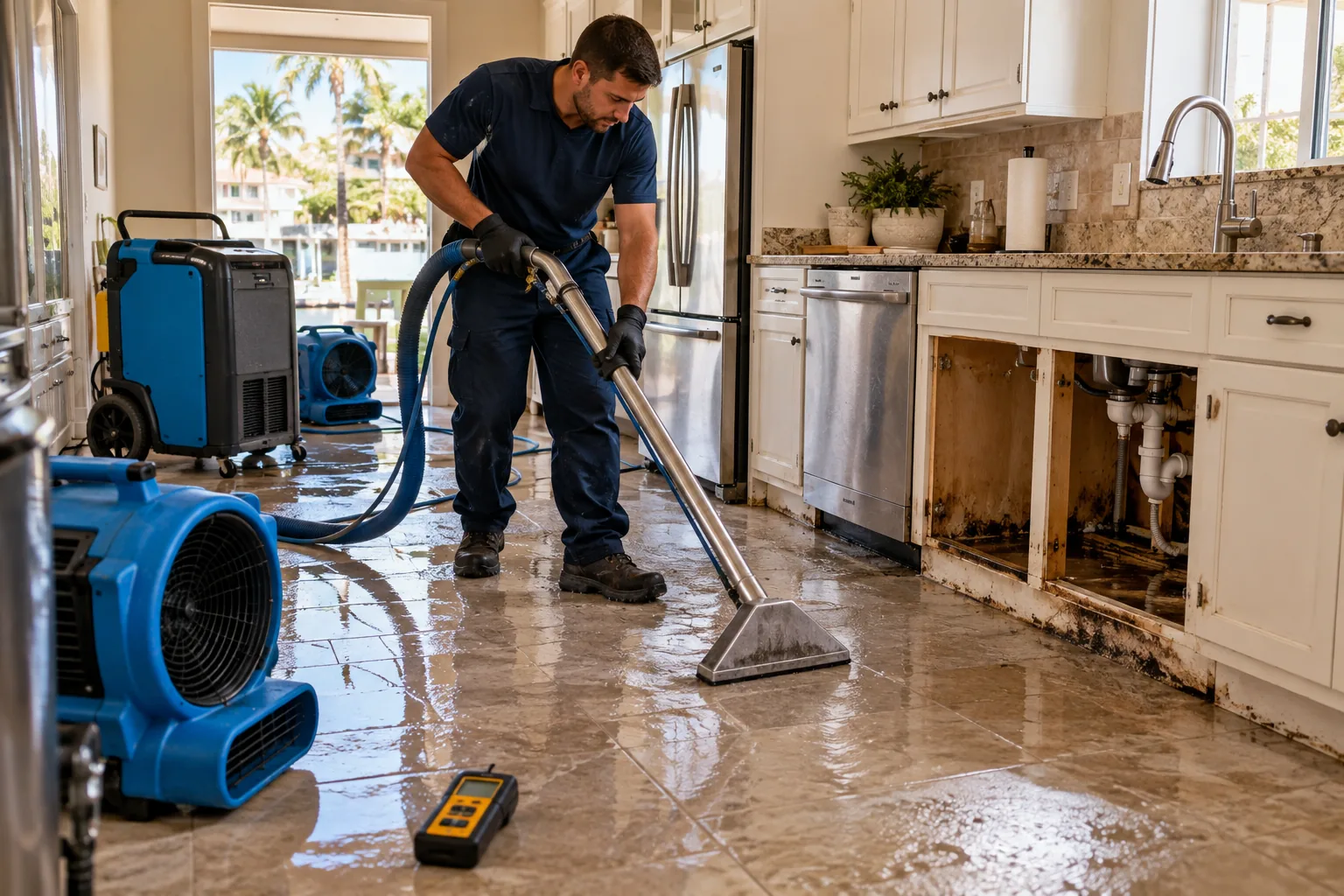
How Much Does Property Damage Restoration Cost in Florida?
Real 2026 Florida cost ranges for water, mold, fire, storm, and biohazard restoration — what drives the price up or down, how insurance and deductibles work here, and how to get an accurate number for your property.
Coverage entries describe the service-area directory and do not represent a physical office at every listed ZIP.
Florida Restoration Costs at a Glance (2026)
Every loss is different, but these statewide ranges — drawn from Florida contractor pricing and insurance scope data — set honest expectations before anyone visits your property. Final pricing always depends on the damage category, affected square footage, materials, and access.
| Damage type | Typical FL range | Per sq ft | Typical timeline |
|---|---|---|---|
| Water damage restoration | $1,300–$5,600 | $3.00–$7.50 | 3–5 days drying |
| Mold remediation | $1,500–$6,000 | $10–$30 | 1–5 days |
| Fire & smoke restoration | $15,000–$60,000+ | $4–$10 (soot cleanup) | 2 weeks–6 months |
| Storm damage restoration | $3,000–$25,000+ | varies widely | 2 weeks–3 months |
| Sewage cleanup | $2,000–$10,000+ | $7–$15 | 2–5 days + rebuild |
| Biohazard cleanup | $1,500–$8,000+ | varies | 1–3 days |
| Emergency roof tarping / board-up | $300–$1,500 | per project | same day |
Ranges reflect typical residential projects. Commercial, high-rise, and historic properties vary. Contents cleaning, pack-out/storage, and full reconstruction are scoped separately.
Water Damage Restoration Cost in Florida
Range: $1,300–$5,600 (roughly $3.00–$7.50 per sq ft). Clean-water losses — a burst supply line caught fast, an overflowing appliance — sit at the low end: extraction, drying, and minor drywall repair. Gray water (appliance discharge, AC overflow) and black water (sewage, floodwater) climb fast because contamination protocols require PPE, containment, antimicrobial treatment, and removal of porous materials.
What moves a water job up or down: how long the water sat (hours vs. days — wicking and mold are the multipliers), what got wet (carpet pad is cheap to replace; hardwood and custom cabinetry are not), whether walls were opened (hidden moisture demands demolition), and contents handling (furnished rooms add pack-out labor). In Florida’s humidity, a $2,000 dry-out found on day one becomes an $8,000+ mold-plus-water project by day four — speed is the cheapest line item.
Mold Remediation Cost in Florida
Range: $1,500–$6,000 for contained residential projects (roughly $10–$30 per sq ft of affected area). A small contained bathroom job can run under $1,500; whole-house remediation or HVAC-involved jobs exceed $6,000. The moisture-source repair — plumbing, roofing, AC drain — is always separate and always necessary: remediation without fixing the source is money thrown away.
Florida adds a cost most states don’t itemize: the law requires a separate licensed mold assessor (MRSA) and remediator (MRSR) on jobs over 10 sq ft, plus independent post-remediation verification (PRV) with air/surface sampling. Budget for the assessment alongside the remediation — it’s not optional here, and it protects you.
Fire Damage Restoration Cost in Florida
Range: $15,000–$60,000+ for full residential fire restoration. Soot and smoke cleanup alone runs $4–$10 per sq ft. The spread comes from four variables: fire size and type (contained kitchen fire vs. whole-room structural fire), soot type (dry soot cleans easily; protein soot from grease fires is invisible, pervasive, and labor-intensive), firefighting water damage (every structure fire includes a water loss — often half the total scope), and contents (cleaning, deodorizing, and storing belongings is a major labor track).
Florida’s humidity shortens the soot clock: acidic residues corrode metals and etch glass faster in moist air, so delayed cleaning converts cleanable surfaces into replacements. Fast response isn’t just better — it’s cheaper.
Storm and Hurricane Restoration Cost in Florida
Range: $3,000–$25,000+ for storm damage; $5,000–$50,000+ after hurricanes. The widest range on this page, because “storm damage” bundles roof/envelope repair, wind-driven water intrusion, tree impact, and sometimes flood — each scoped separately. A tile roof replacement alone runs $15,000–$40,000+.
The number Florida owners must know before the storm: the hurricane deductible — a percentage (commonly 2–10%) of dwelling coverage, not a flat amount. On a $400,000 home at 5%, that’s $20,000 out of pocket before coverage begins. Many “expensive” hurricane restorations are really deductible math, not contractor pricing.
What Makes Any Restoration Cost More (or Less)
Across every peril, the same five levers decide where you land in the range:
Speed of response
The universal multiplier. Water extracted in hours dries; water that sat for days wicks, grows mold, and corrodes. Fast mitigation is always the cheapest money spent.
Contamination level
Clean water vs. sewage, light dust vs. protein soot, surface mold vs. HVAC-colonized — contamination adds PPE, containment, disposal, and specialized labor at every step.
Hidden damage
What’s behind walls and under floors decides the real scope. Professional moisture mapping and thermal imaging find it on day one; skipping assessment finds it as a ‘surprise’ supplement later.
Materials & finishes
Builder-grade drywall and carpet are inexpensive to restore. Hardwood, plaster, stone, and custom millwork multiply both labor and material lines.
Contents volume
Furnished properties need pack-out, cleaning, climate-controlled storage, and return — a parallel project with its own five-figure potential in large homes.
Insurance, Deductibles & What’s Actually Covered
Restoration costs and insurance coverage are two different questions — confusing them is the most expensive mistake Florida property owners make. The short version: sudden, accidental losses (burst pipe, fire, storm wind damage) are typically covered; gradual damage (long-term leaks, wear, neglect) usually isn’t; floodwater needs separate flood insurance, always; and mold is usually capped (often around $10,000) even when the causing leak was covered.
Florida specifics to price into your planning: the percentage-based hurricane deductible, the 1-year hurricane claim filing window, and water/sewer backup endorsements (many policies exclude backup without the rider — check yours now). Emergency mitigation — extraction, tarping, board-up — is generally covered and expected; insurers penalize owners who wait. Our insurance documentation guide covers exactly what to capture from hour one.
How to Get an Accurate Estimate (and Spot a Bad One)
An accurate restoration estimate requires an on-site visit with moisture meters — anyone quoting firm numbers from photos alone is guessing. Expect a written scope with line items (not a single lump sum), separate mitigation vs. reconstruction figures, and documentation of how hidden moisture was assessed.
Green flags
On-site moisture mapping with meters; line-item written scope; mitigation and rebuild estimated separately; license verifiable with the state; documentation package (photos, logs) included; no pressure to sign benefits away.
Red flags
Firm quote from photos only; single lump-sum with no breakdown; demands large upfront deposit; goes door-to-door after storms; asks you to sign Assignment of Benefits on the spot; can’t show a license; price is far below every other bid (corners will be cut somewhere).
After storms
During declared emergencies, Florida’s price-gouging statute applies — report it. Verify licenses at the DBPR, get everything in writing, and never pay in full upfront. Legitimate contractors are busy after storms; the one with immediate availability and the lowest price deserves the most scrutiny, not the least.
The supplement reality
Initial estimates scope visible damage. Demolition routinely reveals hidden damage — handled through insurance supplements, a normal part of the process. A good estimator warns you about this upfront; a bad one pretends the first number is final.
Mitigation vs. Reconstruction: Two Different Bills
One of the most confusing parts of restoration pricing: the mitigation bill (emergency response, extraction, drying, demolition, cleaning) and the reconstruction bill (putting everything back — drywall, flooring, paint, cabinets) are separate scopes, often handled by different crews and paid on different timelines. Mitigation typically runs 30–50% of the total project cost; reconstruction is the rest.
Why this matters for your wallet: insurance usually pays mitigation quickly (it prevents further damage) while reconstruction goes through estimating, approval, and sometimes supplements. Contractors who bundle both into one vague number make it impossible to tell whether you’re overpaying for either phase. Always ask for the split — and be wary of anyone who can’t provide it.
Reconstruction cost drivers unique to Florida: tile and stone flooring (common here, expensive to match), hurricane-code upgrades (if the rebuild triggers code compliance, costs rise — and standard policies may not cover the upgrade without ordinance-and-law coverage), and material lead times after major storms (demand surge pricing is real; Florida’s price-gouging statute applies during declared emergencies).
How Costs Differ: House vs. Condo vs. Commercial
Single-family homes are the baseline for every range on this page. Condos add coordination costs — association approvals, elevator scheduling, multi-unit water mapping — but individual unit scopes are often smaller; the wild card is the special assessment when common elements are damaged (see our condo & HOA guide). Commercial properties scale differently: larger square footage but also business-interruption pressure that makes speed worth a premium — after-hours work, phased occupancy, and code compliance for public spaces all add lines a residential estimate never has.
High-rises (common in South Florida) deserve special mention: containment in shared-air buildings, freight elevator logistics, and multi-floor water migration routinely add 20–40% over an equivalent single-family scope. If your contractor’s estimate doesn’t mention logistics, it’s incomplete.
How Much Does Property Damage Restoration Cost in Florida?: Common Questions
How much does water damage restoration cost in Florida?
Most residential projects fall between $1,300 and $5,600, roughly $3.00–$7.50 per square foot. Clean-water losses caught fast sit at the low end; sewage or floodwater — which requires contamination protocols — costs substantially more.
How much does mold remediation cost in Florida?
Typically $1,500–$6,000 for contained residential projects, or $10–$30 per square foot of affected area. The moisture-source repair is separate, and Florida requires an independent licensed assessor plus clearance verification.
How much does fire damage restoration cost?
Soot and smoke cleanup alone: $4–$10 per square foot. Full residential fire restoration: $15,000–$60,000+ depending on fire size, soot type, firefighting water damage, contents handling, and rebuild scope.
What is a hurricane deductible in Florida?
A separate deductible for named-storm damage, set as a percentage (commonly 2–10%) of your dwelling coverage — not a flat dollar amount. On a $400,000 home at 5%, you pay $20,000 before coverage begins.
Does homeowners insurance cover all restoration costs?
No. Sudden accidental losses are typically covered; gradual damage, wear, and floodwater (without separate flood insurance) aren’t. Mold is commonly capped. Your documentation quality directly affects what gets paid.
Why do restoration estimates vary so much?
Because scopes vary: hidden moisture, contamination level, materials, and contents handling change the real work enormously. Vague lump-sum quotes vary most; detailed line-item scopes from on-site assessments cluster tightly.
Should I get multiple estimates?
For non-emergency work, yes — two or three detailed scopes let you compare. In an active emergency (standing water, open roof), prioritize fast mitigation first; the detailed estimate follows once the property is stable.
What’s not included in a mitigation estimate?
Usually: the source repair (plumber, roofer, HVAC), full reconstruction/rebuild, and sometimes contents cleaning and storage — these are separate scopes. A good estimator tells you this upfront.
Related Services & Resources
Get Help Now — Emergency Line
Active damage can’t wait. Call (833) 606-6010 or request a callback — we’ll talk through your situation and next steps.