Why Property Owners Choose Skyfold Restoration FL
Choosing a restoration company during the worst week of your year shouldn’t feel like a gamble. Here’s exactly how we work, what we commit to, and what we’ll never do — so you can decide with eyes open.
Coverage entries describe the service-area directory and do not represent a physical office at every listed ZIP.
Why Choosing a Restoration Company Feels Impossible
You’re choosing under pressure — water spreading, a house full of soot, a storm-damaged roof with rain coming — from an industry you’ve never hired before, using terminology you’ve never needed. Every company’s website says “fast, professional, trusted.” None of that helps you decide.
So instead of adjectives, here’s our actual operating standard: the specific things we do on every job, the commitments we make in writing, and the lines we won’t cross. Judge us against any competitor on these — we think specificity is the only honest marketing in this business.
What We Commit To — In Writing, On Every Job
These aren’t slogans. They’re how our jobs are run, and you can hold us to them:
emergency live emergency response
When you call (833) 606-6010, you reach help — not a voicemail tree. Active water, fire, storm, or biohazard damage can’t wait for business hours, and neither do we.
IICRC-aligned processes
Our water mitigation follows ANSI/IICRC S500 principles, mold work follows S520, fire work follows S700. These are the industry’s published standards — ask any company you’re evaluating which standard they follow. The ones who can’t name one are telling you something.
Moisture mapping before drying
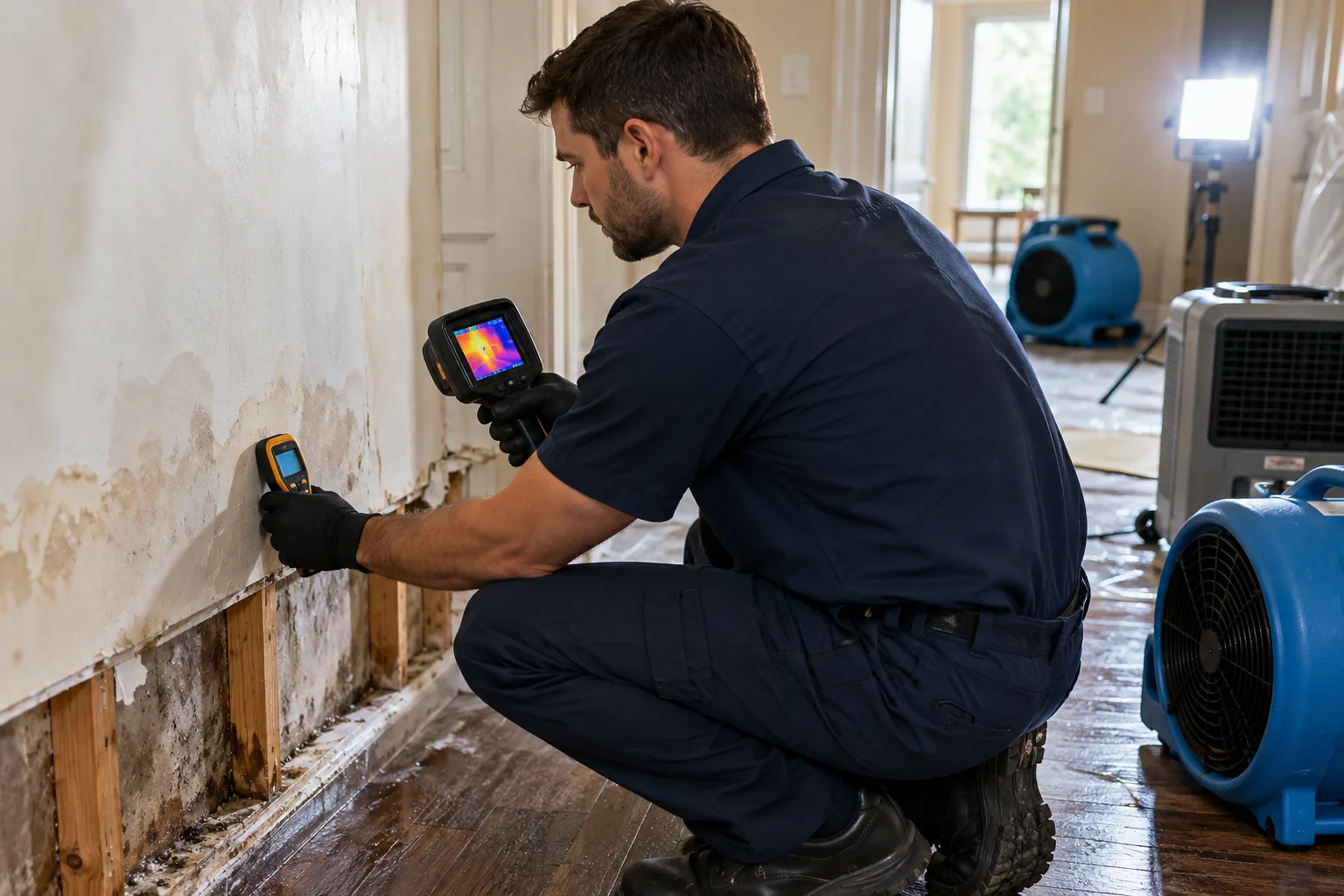
We meter and thermally image the full water path before equipment goes in — and we verify dry standard with instruments before equipment comes out. ‘Looks dry’ is never the endpoint.
Documentation from hour one
Timestamped photos, moisture and drying logs, written scopes, and contents inventories — organized for your insurance claim from the first visit. Good documentation is often worth more than the mitigation itself at claim time.
Separate, line-item estimates
Mitigation and reconstruction are scoped and priced separately, in writing, with line items — never a single vague lump sum. You’ll know exactly what each dollar does.
Florida-licensed mold protocol
On mold jobs over 10 sq ft, assessment and remediation are handled as separate roles per Florida DBPR requirements — with independent post-remediation verification. We don’t test our own work.
No-pressure decisions
We explain the scope, the options, and the claim implications — then you decide. We’ll never ask you to sign over your insurance benefits on the spot or demand large upfront deposits to ‘hold your slot.’
Clean handoffs
When our phase is done, you get the complete file: photos, logs, scopes, invoices — everything your adjuster, your next contractor, or your attorney needs, without having to chase us.
What We Won’t Do — Ever
Half of choosing well is knowing what to avoid. Here’s our list, plainly stated:
No storm-chasing
We don’t go door-to-door after hurricanes pressuring signed contracts. If someone does that to you — from any company — send them away.
No AOB pressure
We won’t ask you to sign an Assignment of Benefits at the door or under time pressure. Understand what any benefits assignment means before signing anything, with anyone.
No phantom guarantees
We won’t promise your claim will be approved, your mold will ‘never come back,’ or a timeline we can’t control. Anyone guaranteeing insurance outcomes is selling something.
No dry-in-place shortcuts
We won’t declare materials dry without meter verification, skip containment to save time, or deodorize over an unremediated source. Shortcuts fail expensively — usually after we’re gone, which is exactly why others take them.
Built for Florida’s Five Perils
Florida isn’t a generic market with palm trees — it’s the country’s highest-risk restoration environment, and the details matter: high water tables and slab-on-grade construction change water jobs; hurricane deductibles and the 1-year filing window change storm claims; DBPR mold licensing changes how mold work is structured; AC condensate leaks and year-round humidity change timelines everywhere.
Our service directory covers 330+ Florida cities across seven regions — South Florida, Central Florida, Tampa Bay, Southwest Florida, the Gulf Coast corridor, North/Northwest Florida, and Polk/inland communities — because restoration here is local work. A Miami high-rise condo loss and a Panhandle hurricane loss have almost nothing in common except the state line.
How to Check Our Work (and Anyone’s)
Don’t take our word for any of this — verify it. Ask us, and ask every competitor:
Which IICRC standard governs this work?
Water: S500. Mold: S520. Fire: S700. A specific answer signals training; a vague one signals the opposite.
How will you verify it’s dry/clean/clear?
Meters and dry standards for water; independent clearance verification for mold; wipe tests and inspection for soot. ‘We’ll know’ isn’t a method.
What exactly is in the scope — line by line?
Demand the written, line-item scope before authorizing work. Compare scopes between bidders, not just totals.
Who handles the mold assessment vs. remediation?
In Florida, these must be separate on jobs over 10 sq ft. One company doing both is a compliance red flag.
What documentation will I receive?
Photos, moisture/drying logs, written scope, invoices, contents inventory. If documentation isn’t part of the deliverable, it won’t exist when your adjuster asks.
What Happens When You Call: The First 48 Hours
Knowing the process removes the fear. Here’s exactly what the first two days look like:
Hour 0–1: The call
You reach a live person at (833) 606-6010. We triage: is water still entering? Is the structure safe? Is power an issue? You get immediate stabilization instructions — what to do and what not to touch — before anyone arrives.
Hours 1–4: Emergency response
For active emergencies, the response team arrives with extraction, containment, or board-up/tarping equipment. The goal of visit one is always the same: stop the damage from growing. Full assessment follows once the property is stable.
Hours 4–24: Assessment & documentation
Moisture mapping with meters and thermal imaging, photo documentation, and a written scope. You’ll know what happened, how far it spread, and what the plan is — in plain language, before authorizing anything beyond emergency mitigation.
Day 2: Scope & claim alignment
You receive the line-item estimate with mitigation and reconstruction separated. We align the documentation with your claim: what your adjuster needs, what the timeline looks like, and what decisions are yours to make. No pressure, no AOB ambush, no deposit demands.
Where We Work
Our service-area directory covers 330+ Florida cities across seven regions — South Florida, Central Florida, Tampa Bay, Southwest Florida, the Gulf Coast corridor, North/Northwest Florida, and Polk/inland communities — with city-level pages detailing local risks, from Miami’s high-rise water losses to Panhandle hurricane response. Coverage entries describe the service-area directory; find your city in the locations directory.
The File You Get: Our Documentation Package
When our work is done, you receive a complete project file — the same package we’d want if it were our home and our claim:
Photo documentation
Timestamped before/during/after photos of every affected area — the visual record adjusters and (if it comes to it) attorneys ask for first.
Moisture & drying logs
Instrument readings from assessment through verified dry standard — proof the structure was actually dried, not just aired out.
Written scopes & invoices
Line-item scopes for mitigation and reconstruction separately, with matching invoices. No lump-sum mysteries.
Contents inventory
Where pack-out was involved: the full barcoded inventory with condition notes and chain-of-custody records.
Clearance & verification
For mold: independent post-remediation verification results. For water: dry-standard verification. For fire: completion inspection records.
Why Property Owners Choose Skyfold Restoration FL: Common Questions
Are you available for emergencies for emergencies?
Yes — (833) 606-6010 is answered prompt. Active water intrusion, fire damage, storm breaches, and biohazard situations can’t wait for business hours.
What areas of Florida do you serve?
Our service-area directory covers 330+ Florida cities across seven regions: South Florida, Central Florida, Tampa Bay, Southwest Florida, the Gulf Coast corridor, North/Northwest Florida, and Polk/inland communities. Use the locations directory to find your city.
Which industry standards do you follow?
ANSI/IICRC S500 for water damage restoration, S520 for mold remediation, and S700 for fire and smoke restoration — the restoration industry’s published consensus standards.
Will you help with my insurance claim?
We document everything claim-relevant from hour one — photos, moisture and drying logs, written scopes, contents inventories — and organize it for your adjuster. We don’t guarantee claim outcomes; no honest company can.
Do you require large upfront deposits?
No. We don’t demand large upfront payments to ‘hold your slot’ or pressure anyone into signing over insurance benefits. Scopes and payment terms are in writing before work begins.
How is mold handled differently in Florida?
Florida DBPR licenses mold assessors and remediators separately — the same company can’t do both on the same job over 10 sq ft. We follow that separation and use independent post-remediation verification.
Related Services & Resources
Get Help Now — Emergency Line
Active damage can’t wait. Call (833) 606-6010 or request a callback — we’ll talk through your situation and next steps.