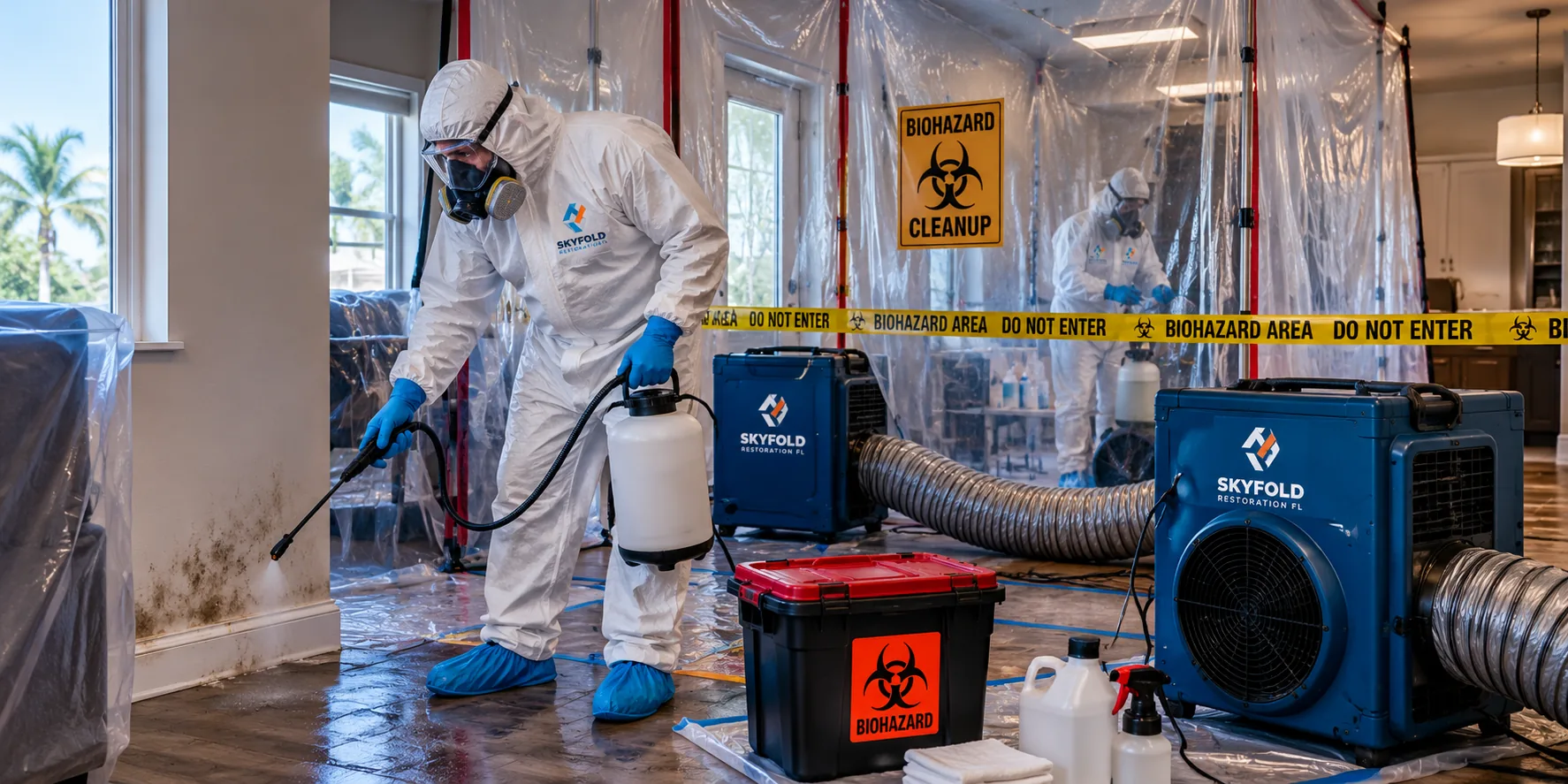
Decontamination & Sanitization in Florida
Containment and specialty cleaning for affected areas requiring controlled sanitation.
Coverage entries describe the service-area directory and do not represent a physical office at every listed ZIP.
Common situations connected to decontamination & sanitization
This page explains the service in plain language, connects it to related restoration work and provides a path to the city-level service pages where that coverage exists.
Biological Contamination
The response should follow the source, material condition, access and safety considerations.
Controlled Cleaning
The response should follow the source, material condition, access and safety considerations.
Surface Decontamination
The response should follow the source, material condition, access and safety considerations.
Affected Areas
The response should follow the source, material condition, access and safety considerations.
Containment
The response should follow the source, material condition, access and safety considerations.
Odor Control
The response should follow the source, material condition, access and safety considerations.

Use the supporting service to solve the actual problem, not just the visible symptom.
Containment and specialty cleaning for affected areas requiring controlled sanitation. A useful work plan considers what caused the condition, which materials are affected, what needs to be protected, and what documentation is needed before the next stage.
A practical decontamination & sanitization workflow
Initial call and scope review
The work scope should be based on verified conditions and the requirements of the property.
Safety and access assessment
The work scope should be based on verified conditions and the requirements of the property.
Service-specific work
The work scope should be based on verified conditions and the requirements of the property.
Documentation and progress checks
The work scope should be based on verified conditions and the requirements of the property.
Related restoration review
The work scope should be based on verified conditions and the requirements of the property.
Next-step planning
The work scope should be based on verified conditions and the requirements of the property.
How decontamination & sanitization can connect to broader restoration
Water Damage Restoration
Water extraction, cleanup, moisture assessment, structural drying and restoration planning for homes and businesses.
Fire Damage Restoration
Fire, smoke and soot cleanup with property stabilization, contents coordination, odor control and restoration planning.
Storm Damage Restoration
Storm and hurricane damage response for roof intrusion, wind damage, flooding, debris and temporary property protection.
Biohazard Cleanup
Professional biohazard cleanup, containment, decontamination and sanitation for sensitive property situations.
What Affects Decontamination & Sanitization Cost in Florida?
Professional decontamination and sanitization in Florida typically costs $800 to $5,000 depending on square footage, contamination type, and verification requirements. Post-remediation sanitization, trauma-adjacent decon, and commercial infection-control scopes sit at different points in the range.
Square footage
Costs scale with area — a single room vs. a whole commercial floor. Large open areas are efficient; compartmentalized spaces take longer.
Contamination type
Post-mold-remediation sanitization, sewage-adjacent decon, and infectious-disease protocols each use different chemistries and PPE levels.
Verification level
Visual verification vs. ATP testing vs. third-party sampling — higher assurance levels add testing cost but prove the result.
Contents involvement
Decontaminating contents and equipment alongside the structure adds handling, cleaning, and documentation labor.
How Decontamination & Sanitization Works, Step by Step
Decontamination is applied microbiology: the right EPA-registered chemistry, at the right concentration, for the right dwell time — then verification.
1. Contamination assessment
The contamination type and extent are identified — microbial, sewage-adjacent, or infectious — because chemistry follows the target.
2. Pre-cleaning
Visible soil and debris are removed first. Disinfectants can’t penetrate soil — cleaning always precedes disinfection.
3. Application at label dwell time
EPA-registered disinfectants are applied at label concentrations and kept wet for the full dwell time. Shortcuts here are the #1 cause of decon failure.
4. HEPA filtration & air treatment
Air scrubbers capture airborne contaminants during and after treatment; hydroxyl generators address airborne and surface residuals.
5. Verification
ATP testing or equivalent verifies sanitization levels against benchmarks. The verification report documents the outcome.
Decontamination in Florida: Humidity Fights Your Chemistry
Florida’s humidity complicates decontamination two ways: moisture dilutes and shortens disinfectant dwell times on surfaces, and humid environments re-grow microbial contamination faster after treatment. Professional decon here pairs chemistry with dehumidification — dry the environment, then disinfect it, then keep it dry.
Common Florida decon scenarios: post-mold-remediation sanitization, post-sewage structural disinfection, rental turnover sanitization, and commercial infection-control. For mold-related decon, remediation per IICRC S520 comes first — disinfecting over an active colony without removing it is theater.
Emergency
Active decontamination & sanitization in Florida? Call (833) 606-6010 now — fast response limits secondary damage.
Decontamination & Sanitization questions
When is decontamination & sanitization needed?
The answer depends on the loss, affected materials and current site conditions. A property-specific assessment is more reliable than a one-size-fits-all checklist.
What does decontamination & sanitization involve?
Containment and specialty cleaning for affected areas requiring controlled sanitation. The exact scope should follow the actual property conditions.
How does decontamination & sanitization connect to other restoration work?
Supporting services are often connected to a broader loss. For example, water extraction may lead into structural drying, while storm damage may lead into tarping and interior water mitigation.
What’s the difference between cleaning, sanitizing, and disinfecting?
Cleaning removes soil. Sanitizing reduces bacteria to safe levels. Disinfecting destroys specified pathogens per EPA label claims — it requires the right product, concentration, and dwell time.
How do you verify decontamination worked?
ATP testing measures organic residue on surfaces against benchmarks — it’s the standard field verification. Third-party microbial sampling is available for higher-assurance needs.
Can decontamination replace mold remediation?
No. Disinfectants don’t remove established mold colonies from porous materials — remediation (containment, removal, HEPA filtration per IICRC S520) comes first; sanitization finishes the job.
Is professional decontamination safe for occupied spaces?
Yes when done properly — products are EPA-registered, applied per label, and spaces are ventilated. Hydroxyl treatment can even run in occupied areas.
Related Restoration Services
Damage rarely involves just one trade. These services commonly connect to decontamination & sanitization projects.