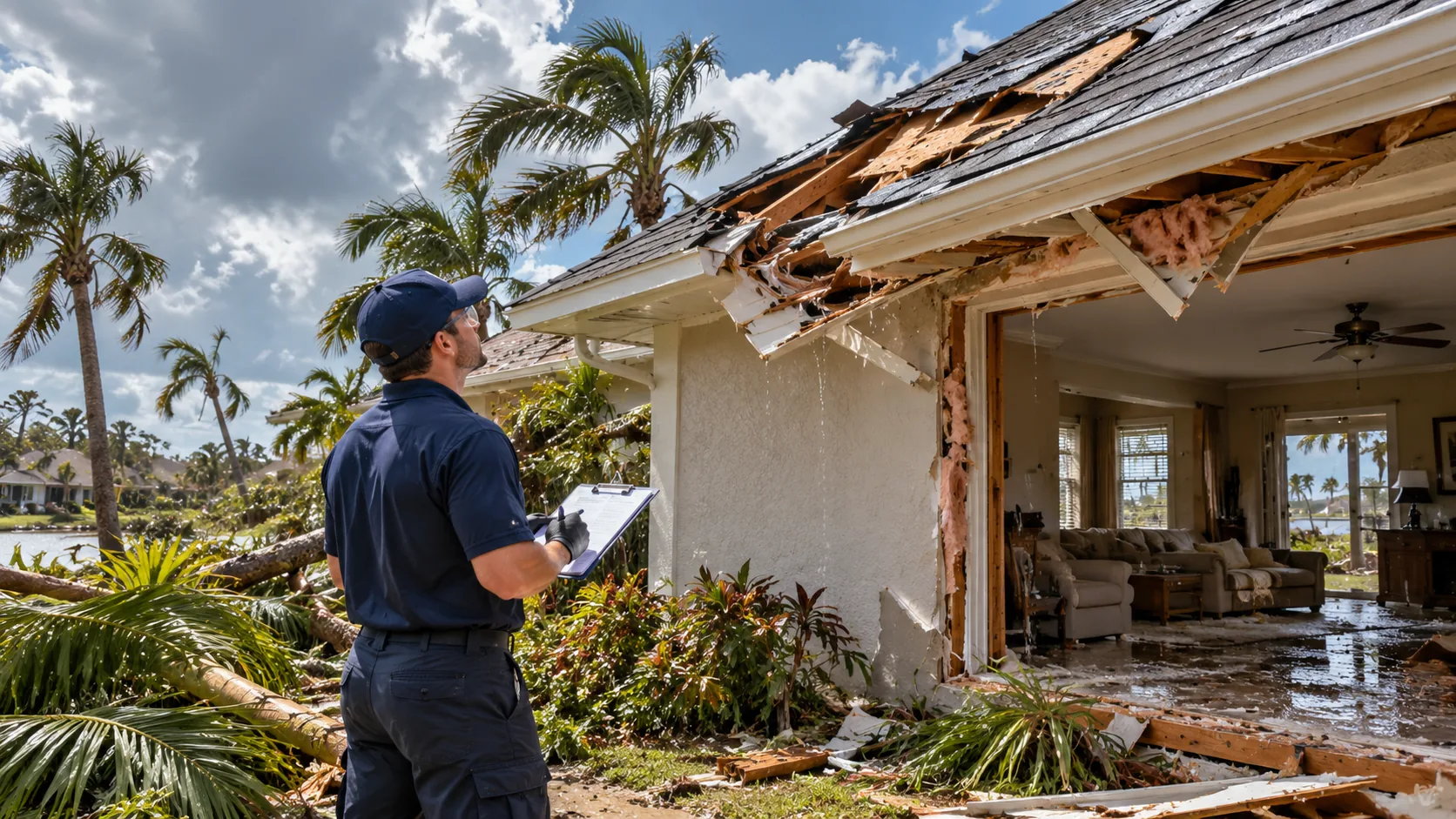
Your roof has a hole, more rain is coming, and the roofer can't get there for two weeks. This is exactly what emergency roof tarping is for. Done right, a tarp stops the bleeding — preventing a manageable repair from becoming a whole-house water disaster. Done wrong, it's a blue sail that shreds in the next gust. Here's what proper tarping looks like and why it matters.
Why does temporary roof tarping matter so much after a storm?
The short answer: Because every additional rain on an open roof multiplies the damage: more water in the attic, more saturated insulation, more ceiling and wall damage, and a longer mold timeline. A $500–$1,500 tarp job routinely prevents $10,000+ in additional interior damage — it's the highest-ROI emergency action in storm recovery.
Think of the storm as round one and every subsequent rain as round two, three, and four — except you're defenseless now. Florida's storm season doesn't pause for contractor scheduling; afternoon thunderstorms arrive daily. An untarped breach converts a roof repair into a roof repair plus interior water remediation plus mold remediation. The tarp breaks that chain. It's also a legal expectation: your insurance policy requires you to mitigate further damage, and "I was waiting for the roofer" isn't mitigation — a tarp is.
What does proper roof tarping look like?
The short answer: A heavy-duty (at least 6-mil, preferably reinforced) tarp extending from the roof ridge down past the damaged area — never just covering the hole — secured with wood battens screwed through the tarp edges into the roof (not nails through the tarp field), with the top edge tucked under the ridge or properly flashed so water sheds over the tarp, not under it.
The details are what separate a tarp that survives from one that doesn't. "Ridge to eave" coverage matters because water runs downhill — a tarp that starts below the ridge lets water run underneath it from above. Battens (1x2 or 2x2 lumber) distribute wind load; nails or staples through the tarp field just create tear points and new leak paths. Edges get wrapped around the battens ("burrito wrap") so wind can't get underneath. On tile roofs, tarps go over the tiles with careful securing that doesn't create new damage. This is skilled work at height — which is why professional emergency tarping exists.
Tarping done right vs. done wrong
| Right | Wrong |
|---|---|
| Ridge-to-past-damage coverage | Small patch just over the hole |
| Batten-secured edges | Nails/staples through the tarp field |
| Water sheds over the top edge | Top edge left for water to run under |
| 6-mil+ reinforced polyethylene | Thin painter's plastic or bed sheets |
| Installed by equipped professionals | DIY on a wet, damaged roof |
How long does a roof tarp last?
The short answer: A properly installed heavy-duty tarp lasts weeks to a few months — long enough to bridge the gap to permanent repair. UV sunlight degrades the plastic, wind works the fasteners loose, and ponding water stresses the material. It's a bridge, not a destination.
Plan the permanent repair from day one; don't let the tarp become the plan. After major hurricanes, roofer backlogs stretch for months — which is exactly when tarp quality matters most. Check the tarp after every significant wind event, and if it starts flapping, billowing, or ponding, get it re-secured before the next rain. Some owners need two tarp cycles to reach their permanent repair date; that's normal after widespread events.
Will insurance pay for emergency tarping?
The short answer: Yes — emergency tarping is textbook mitigation, and insurers routinely reimburse it as part of the storm claim. Keep the invoice, photograph the tarp in place, and document the damage it was covering. Some insurers even deploy tarping contractors directly after major events.
This is one expense you should never hesitate over. The policy language requiring you to "protect the property from further damage" is precisely what tarping fulfills — and the cost is trivial compared to the interior damage it prevents. If a contractor suggests skipping the tarp to save money, that's a red flag about their understanding of both mitigation and claims. Document the before (damage), the during (tarp installation), and keep every receipt for the claim file — our documentation guide has the full checklist.
What comes after the tarp?
The short answer: Three parallel tracks: the roof itself (professional assessment, then repair or replacement), the interior water damage (moisture mapping, drying, remediation of what the breach already let in), and the insurance claim tying both together with documentation.
Don't forget the interior track — it's the one owners miss. The tarp stops new water; it does nothing about the water already inside your attic, insulation, and walls from before the tarp went up. That moisture needs the full treatment: mapping, drying, and verification, as described in our roof leak guide. A roof repaired over a moldy attic is a job half done. For cost expectations on both halves, see our Florida restoration cost guide.
Dealing with this right now?
You don't have to figure out the next step alone. Call and describe what you see — where the damage is, how long it's been there, and whether it's still spreading — and you'll get a straight answer about what to do next.
Call (833) 606-6010 Request help online
emergency line. If there's an active life-safety danger, call 911 first. Email: help@skyfoldrestorationfl.com
Frequently asked questions
How much does emergency roof tarping cost in Florida?
Typically $500–$1,500 for a standard residential tarp, depending on roof size, pitch, damage extent, and accessibility. Steep, high, or tile roofs cost more. After major hurricanes, demand pricing can push higher — another reason to act fast. It's reimbursable as emergency mitigation under most storm claims.
Can I tarp my own roof to save money?
Technically yes, practically please don't. Post-storm roofs combine the three ingredients of fall injuries: wet surfaces, hidden structural damage, and urgency-induced carelessness. Professional crews have harnesses, experience, and can usually do in an hour what takes a homeowner a dangerous afternoon.
Will a tarp damage my roof further?
A properly installed tarp (batten-secured, no field penetrations) causes minimal additional impact. A poorly installed one — nails everywhere, flapping edges — absolutely can. This is another argument for professional installation: the securing method matters as much as the coverage.
What if it keeps raining before anyone can tarp?
Interior mitigation: place buckets, move belongings, puncture bulging ceilings controllably to release water (bucket ready, stand aside), and document everything. Then get the tarp up at the first safe opportunity. Every hour of additional intrusion compounds the interior scope.
Does a tarp work on flat roofs?
Yes, with different technique — flat roofs pond water, so tarps need careful securing and drainage planning to avoid creating a waterbed that stresses the structure. Ponding on a tarp over a compromised flat roof needs professional judgment; get help rather than improvising.
How do I know if my tarp is failing?
Flapping or billowing edges, visible ponding, torn sections, loose battens, or water stains appearing in new interior locations. Inspect after every wind event. A failing tarp is worse than no tarp if it channels water somewhere new — re-secure promptly.