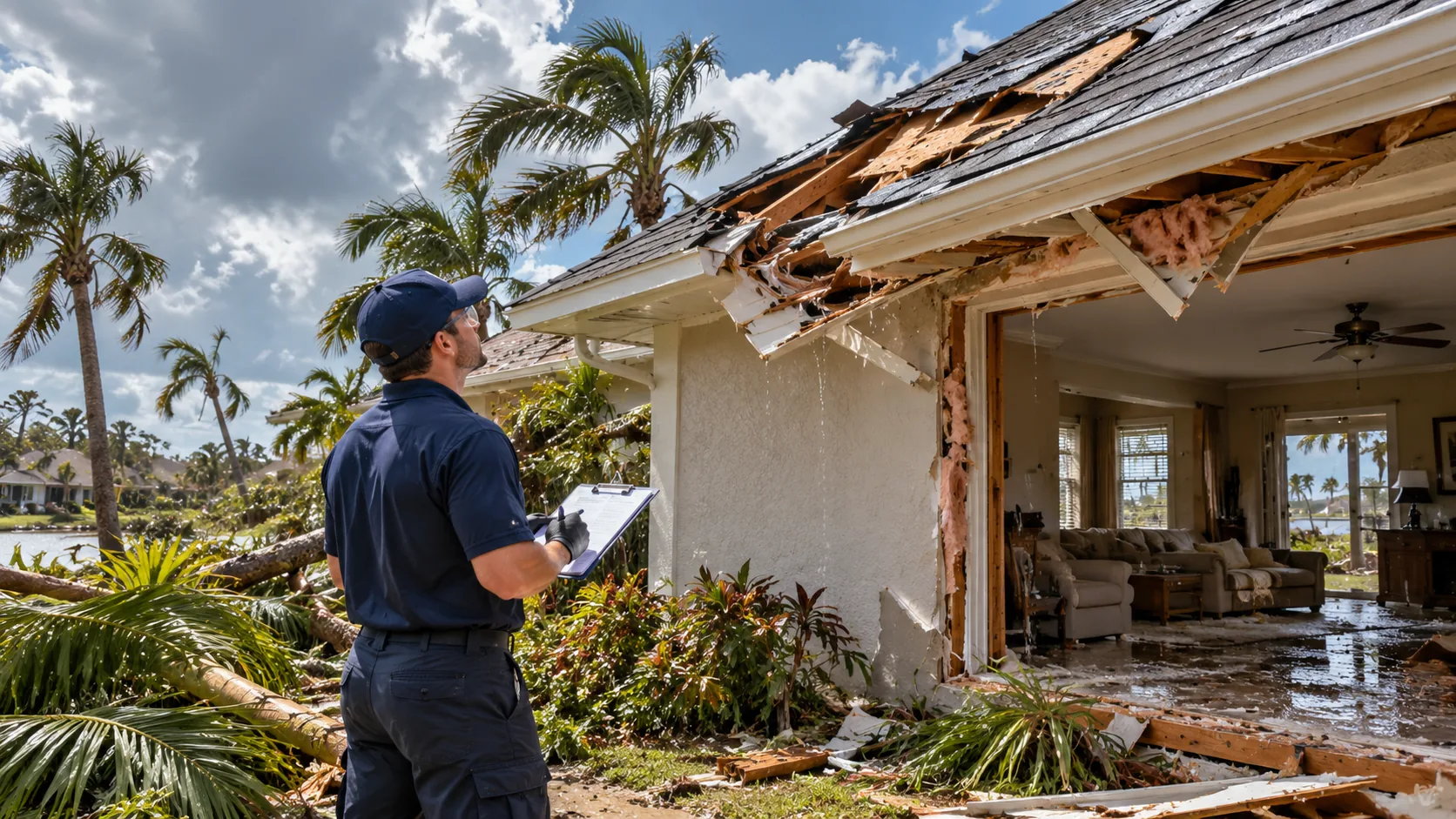
The storm passed three days ago. Now there's a brown stain blooming on your bedroom ceiling. Welcome to the delayed roof leak — one of the most common and most misunderstood storm damage scenarios in Florida. The water entering your home today may have started its journey during the storm's peak winds. Here's how it happens and what to do.
How does storm damage create a roof leak?
The short answer: High winds lift, crack, or tear off shingles and tiles; flying debris punctures the roof surface; wind-driven rain exploits the breaches; and compromised flashing around vents, chimneys, and valleys lets water in. The water then travels along the underlayment, deck, and framing — sometimes for many feet — before finding a path through your ceiling.
Two Florida-specific factors make this worse. First, tile roofs: the tiles themselves aren't the waterproof layer — the underlayment beneath is. Wind can crack tiles or displace them just enough to expose underlayment, which then deteriorates under UV and water exposure. The roof looks fine from the street while leaking steadily. Second, our rain doesn't fall politely downward — hurricane winds drive it horizontally and even upward under shingle edges and flashing, exploiting vulnerabilities that normal rain never would. More on that in our wind-driven rain guide.
Common breach points, in order of frequency
- Ridge and hip caps: the first to lift in high wind — and a breach here admits water along the entire ridge line.
- Flashing: around vents, skylights, chimneys, and in valleys — wind flexes it, sealant fails, water follows.
- Field shingles/tiles: lifted, cracked, or missing — each is a direct water path.
- Debris punctures: branches and projectiles punch through, often in spots you'd never suspect.
- Gutters and fascia: torn gutters expose the roof edge and let water behind the fascia into the soffit and walls.
Why didn't the leak show up during the storm?
The short answer: Because water's journey from breach to ceiling takes time. It saturates underlayment, runs along the deck, pools on top of ceiling drywall, and only drips through once the drywall saturates — a process that takes days to weeks. Insulation in the attic slows it further by absorbing water first.
This delay fools people twice: first into thinking their roof survived ("no leaks during the storm!"), then into treating the stain as a new problem when it's actually a weeks-old one. By the time you see the stain, the attic insulation above it is soaked, the framing has been wet for days, and mold may already be starting. The correct response to a post-storm ceiling stain is urgency proportional to a weeks-old leak, not a new one. Get the roof inspected and the interior moisture-mapped promptly — our storm restoration service handles both halves.
What should I do when I find a storm roof leak?
The short answer: Two tracks, simultaneously: (1) stop more water from entering — emergency roof tarping if the breach is still open; (2) address the interior water — contain drips, move belongings, document, and arrange moisture mapping and drying. Then get a roofer's assessment of the breach itself.
The tarping decision is time-sensitive: every additional rain on an open breach compounds the interior damage. If the roof is still admitting water, interior drying is pointless until the entry is controlled — you'd be bailing a boat with a hole in the hull. Conversely, tarping without interior remediation leaves weeks-old moisture growing mold in the dark. Both tracks, same week. For the full tarping playbook, see our roof tarping guide.
Will insurance cover the roof and the interior damage?
The short answer: Typically yes for both when a storm caused the breach: the roof repair (subject to your hurricane/wind deductible, which in Florida is often a percentage of dwelling coverage) and the interior water damage resulting from the storm-created opening. Document the breach and the interior damage as one connected event.
The Florida wrinkle is the hurricane deductible — commonly 2%–5% of your dwelling coverage, meaning a $300,000 policy carries a $6,000–$15,000 deductible for hurricane damage. Know your deductible before the storm; many owners discover it for the first time at claim time. Also understand: insurers distinguish storm-created openings (covered) from wear-and-tear leaks (not covered). Your documentation — photos of the lifted shingles, the debris, the storm's date — is what proves the difference. Our cost guide walks through deductibles and coverage in detail.
How do I find the actual breach when the stain is far from it?
The short answer: Start in the attic: look for daylight, water trails on the underside of the deck, wet insulation, and staining on framing — water's path is usually visible from above even when it's hidden from below. Trace the trail upslope to the entry point. Thermal imaging from inside can also map the wet path back to its source.
The attic is the detective's office for roof leaks. Go up during daylight (with proper safety precautions — watch your step, attics have uncovered joists) and look for the subtle signs: darkened wood, damp insulation, rusted nail heads, daylight pinpricks. The trail almost always leads upslope from the interior stain. If you're not comfortable in the attic, a professional roof inspection with moisture mapping finds it without guesswork — and the inspection report itself becomes claim evidence.
Dealing with this right now?
You don't have to figure out the next step alone. Call and describe what you see — where the damage is, how long it's been there, and whether it's still spreading — and you'll get a straight answer about what to do next.
Call (833) 606-6010 Request help online
emergency line. If there's an active life-safety danger, call 911 first. Email: help@skyfoldrestorationfl.com
Frequently asked questions
How long can a roof leak go unnoticed?
Weeks to months, especially with tile roofs and slow breaches. Attic insulation absorbs significant water before any interior sign appears. Annual roof inspections — and an attic check after every major storm — catch what the ceilings don't show.
Is a small roof leak a big deal?
Yes — "small" describes the entry, not the damage. A pinhole breach admitting water for two months can rot framing, saturate insulation across a wide area, and grow extensive mold. Small entry, large consequences: that's the rule with roof leaks.
Can I tarp my own roof?
It's possible but genuinely dangerous — post-storm roofs are wet, potentially structurally compromised, and falls are a leading cause of post-storm injuries. Professional tarping is fast, safe, and usually reimbursable as emergency mitigation. This is one DIY to skip.
What's the difference between a roof leak and condensation?
Condensation forms from interior humidity on cold surfaces (rare in Florida's climate but possible with AC ducts in attics); roof leaks come from outside. If the moisture appears after rain or storms, it's a leak. If it's constant regardless of weather, investigate ventilation and duct issues.
Will a roof leak cause mold in the attic?
Very likely if not addressed — dark, humid attics with wet wood and insulation are ideal mold environments in Florida's climate. Attic mold from roof leaks is one of the most common findings in post-storm inspections. Speed matters: dry the attic, don't just fix the shingle.
How often should Florida roofs be inspected?
Annually, plus after every tropical storm or hurricane — even if you see no interior signs. The delayed-leak pattern means "looks fine" isn't reliable. Inspections are inexpensive; the leaks they catch are not.