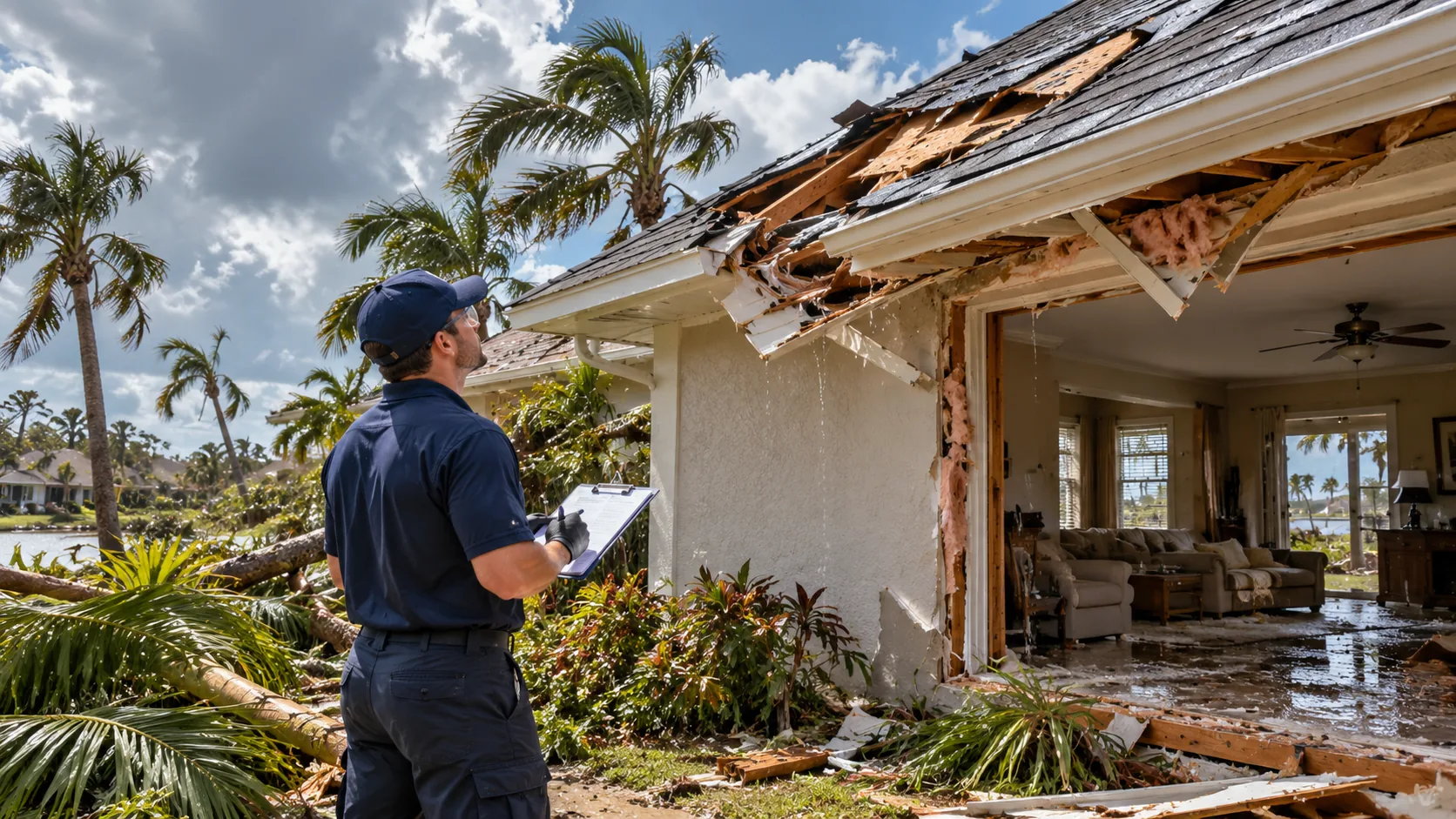
Most people picture rain falling from the sky onto a roof. In a Florida hurricane, rain moves like a pressure washer held sideways — driven by 100+ mph winds into every seam, gap, and edge of your building. Wind-driven rain is responsible for a huge share of hurricane interior water damage, and it's the sneakiest kind: the building can look intact while water pours into the walls.
What is wind-driven rain, exactly?
The short answer: Rain carried by high winds so that it strikes buildings horizontally (or even upward) instead of vertically. At hurricane wind speeds, water is forced under shingle edges, behind siding, through window seals, into soffit vents, and through any small envelope breach — paths that gravity-fed rain would never take.
The physics matter: normal rain hits your roof and sheds off. Wind-driven rain at 110 mph has the impact energy to travel up a roof slope under shingle tabs, to push through the weep holes and seals of windows, and to enter attic vents designed for airflow, not water exclusion. Building envelopes are engineered primarily against gravity-driven water; wind-driven rain attacks the assumptions the engineering was based on. That's why a roof can be "intact" (no missing shingles) and still admit significant water in a hurricane.
Where does wind-driven rain get in?
The short answer: The usual suspects: window and sliding-door perimeters (seals flex and fail under wind pressure), under lifted shingle or tile edges, soffit and gable vents (designed to breathe, not to block horizontal water), wall penetrations (hose bibs, vents, light fixtures), and anywhere siding or stucco has cracks or gaps.
- Windows and doors: the #1 interior water source in hurricanes without structural failure. Wind pressure flexes frames, overwhelms weep systems, and drives water past weatherstripping — especially in older windows and sliding glass doors.
- Soffits: wind gets under the eaves and pushes water up into the soffit vents and straight into the attic. Attic water stains after a hurricane often trace to soffits, not the roof field.
- Wall assemblies: stucco cracks, siding gaps, and penetrations admit water that then runs down inside the wall cavity — invisible until it reaches an outlet, baseboard, or the floor below.
- Roof edges: the eave and rake edges take the worst wind uplift; even slightly lifted edges admit driven rain along the deck.
How do I know if wind-driven rain got into my walls?
The short answer: Look for the subtle signs in the weeks after a storm: musty odors, paint bubbling near windows and baseboards, swollen trim, outlet covers with moisture or staining, and wallpaper or paint peeling at wall bases. Then verify with moisture meters — pin readings on baseboards and around windows reveal what eyes can't.
This is the damage that gets missed in the post-storm rush, because everyone's focused on the obvious: the missing shingles, the fallen fence. Meanwhile water sits inside wall cavities, and by the time it's visible, there's mold. The smart post-hurricane move — even for buildings that "did fine" — is a moisture check of vulnerable areas: window perimeters, exterior walls on the windward side, and the attic. It's inexpensive, non-invasive, and catches the problems that become expensive six months later. Our hidden water damage guide details the full early-warning list.
How do you fix wind-driven rain damage?
The short answer: Dry what can be dried (wall cavities via injection drying or controlled opening, attic spaces with dehumidification), remove what can't (saturated insulation, colonized drywall), seal the entry points (window resealing, flashing repair, soffit screening), and verify everything with moisture readings before closing up.
The repair has two halves that must not be confused: the water half (drying and remediation of what got wet) and the envelope half (fixing the entry points so the next storm doesn't repeat it). Drying without sealing is temporary; sealing without drying traps moisture. For the water half, structural drying with cavity-specific techniques handles what surface drying can't. For the envelope half, a qualified contractor (roofer, window specialist, or general contractor depending on the entry points) addresses the vulnerabilities the storm exposed. And document both halves for the claim — see our documentation guide.
Can I prevent wind-driven rain intrusion?
The short answer: You can't prevent it entirely in a major hurricane, but you can reduce it significantly: maintain window and door seals (replace worn weatherstripping), keep caulking at penetrations intact, ensure the roof edge and flashing are sound, consider storm shutters (they reduce both wind pressure and direct water impact on windows), and keep gutters clear so water sheds properly.
The unglamorous truth: most wind-driven rain entry exploits maintenance gaps, not design flaws. The ten-year-old cracked caulk around the hose bib, the weatherstripping that's been compressed flat since 2019, the flashing sealant that dried out — these are what the hurricane finds. An annual envelope walk-around (caulk, seals, flashing, vents) is the highest-value hurricane prep most owners never do. More in our prevention and preparedness FAQs.
Dealing with this right now?
You don't have to figure out the next step alone. Call and describe what you see — where the damage is, how long it's been there, and whether it's still spreading — and you'll get a straight answer about what to do next.
Call (833) 606-6010 Request help online
emergency line. If there's an active life-safety danger, call 911 first. Email: help@skyfoldrestorationfl.com
Frequently asked questions
Is wind-driven rain damage covered by insurance?
Generally yes under the windstorm portion of your homeowners policy, when the water enters through storm-created openings or as a direct result of hurricane winds. Keep the distinction clear in documentation: photograph the openings/breaches (wind damage) and the resulting interior water (ensuing damage) as connected evidence.
Why did my windows leak during the hurricane?
Wind pressure flexes window frames and overwhelms drainage/sealing systems designed for normal rain. Older windows, sliding glass doors, and any window with worn weatherstripping are most vulnerable. Leaking during extreme wind doesn't necessarily mean the windows are defective — but recurring leaks in normal rain mean they need service.
How long after a hurricane should I watch for signs?
At least 4–8 weeks. Interior wall-cavity moisture takes time to manifest as visible symptoms, and Florida's humidity keeps it active. Do a deliberate re-check of vulnerable areas a month after the storm — not just the week after.
Can wind-driven rain affect a home with no roof damage?
Absolutely — windows, soffits, vents, and wall penetrations admit water independently of roof condition. "Roof looks fine" doesn't mean "building stayed dry." Check the walls and attic, not just the shingles.
Do storm shutters prevent wind-driven rain?
They significantly reduce it at windows and doors by blocking direct wind pressure and water impact on the glazing and seals. They don't help with soffit, vent, or wall-penetration entry — but windows are the biggest interior water source, so shutters are high-value protection.
What's the difference between wind-driven rain and flooding?
Wind-driven rain enters through the building envelope above ground (windows, walls, roof, vents) due to wind; flooding is rising water from the ground (storm surge, overflowing waterways). Insurance treats them very differently — wind-driven rain typically falls under homeowners/wind coverage, flooding requires flood insurance. Document which one caused each area of damage.