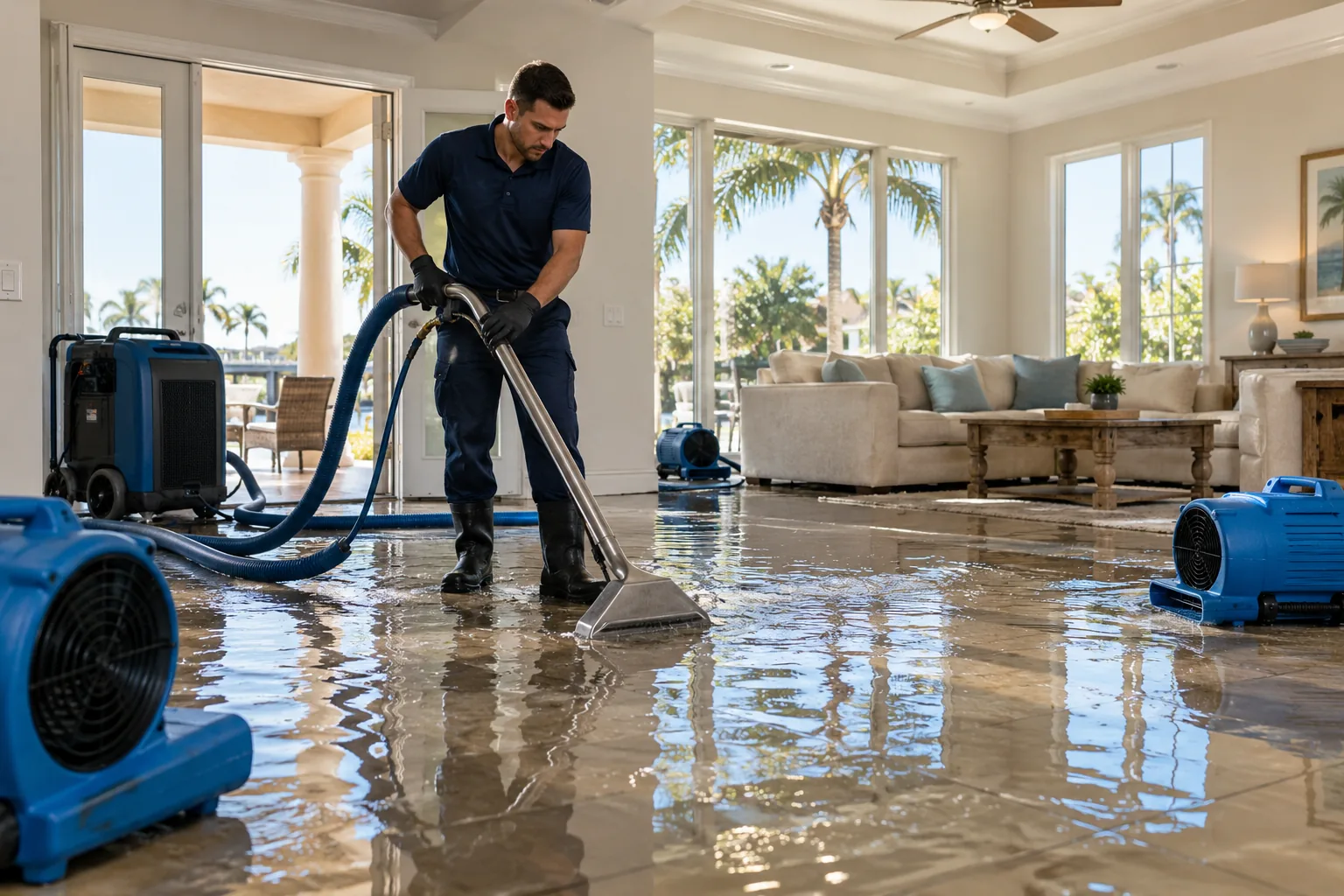
Water Damage FAQs
Water Damage FAQs for Florida property owners. Clear answers about safety, emergency steps, cleanup, drying, documentation and restoration planning.
Coverage entries describe the service-area directory and do not represent a physical office at every listed ZIP.
Water Damage FAQs
Straight answers about water damage in Florida homes and businesses — what to do first, how drying works, what insurance covers, and when to call for help. For deeper dives, see our related guides linked below.
What counts as water damage vs. flooding?
The short answer: Water damage generally means water from inside sources (burst pipes, appliance failures, roof leaks) or wind-driven intrusion — typically covered by homeowners insurance. Flooding means rising water from outside (storm surge, overflowing waterways) — covered only by separate flood insurance. The distinction determines which policy pays.
This is Florida's most expensive insurance misunderstanding. A hurricane can cause both simultaneously: wind tears the roof (homeowners claim) while surge floods the ground floor (flood claim). Document each separately — photograph the roof breach and the water line as distinct evidence. If you only carry homeowners insurance, understand now what it won't cover.
How quickly should water damage be addressed?
The short answer: Emergency mitigation should begin within hours, and professional drying within 24 hours is the goal. Every day of delay increases the scope: more material saturation, higher mold risk, and more demolition. In Florida's humidity, the timeline compresses further — wet materials here don't get the grace period they might in Arizona.
Practical priority: stop the source (main valve, plumber), remove standing water, get air moving, and call for assessment the same day. You don't need to have everything figured out to start — extraction and documentation can begin while the larger plan takes shape. Our burst pipe guide walks through the first hour step by step.
Can water damage be hidden?
The short answer: Very often. Water wicks into wall cavities, under flooring, above ceilings, and into insulation — all invisible from the room. Musty odors, unexplained humidity, and water bill spikes are the classic signs of hidden damage. Thermal imaging and moisture meters find what eyes can't.
The danger of hidden damage is the timeline: by the time it's visible, it's old. A six-month-old wall cavity leak means six months of mold growth and rot. If anything suggests hidden moisture — especially after a storm or plumbing event — get it mapped professionally rather than waiting for visible proof. See our hidden damage signs guide.
What affects how long water damage takes to fix?
Three variables drive the timeline more than anything else: the water category, the materials affected, and how fast drying starts. Clean water from a supply line in a tile-floored kitchen might be resolved in three to four days. The same volume of water in a carpeted bedroom with drywall wicking can take a week or more, because porous materials hold water in their fibers and release it slowly.
Florida's climate adds a fourth variable. Outdoor air here often sits at 70–90% relative humidity, so drying equipment has to work against constant moisture intrusion every time a door opens. Professionals compensate with containment barriers and commercial dehumidifiers sized to the space — typically targeting indoor humidity below 50% during the drying phase. A common homeowner mistake is turning the AC way down thinking cold air dries faster; cold air actually holds less moisture, which slows evaporation from materials.
- Fast wins: tile, concrete, and metal release water quickly and usually dry in place.
- Slow materials: drywall, carpet pad, insulation, and hardwood hold water and often need removal or extended drying.
- Hidden water: moisture inside wall cavities or under flooring can double the timeline if not detected with meters or thermal imaging.
When does water damage become a mold problem?
Mold doesn't wait for permission. Given moisture, a food source (drywall paper, wood, dust), and Florida's warm temperatures, microbial growth can begin within 24–48 hours of a water event. That's why the drying timeline and the mold timeline are really the same timeline — every day materials stay wet is a day mold gets closer.
The practical threshold: if porous materials like drywall or carpet pad stay wet beyond about 48 hours, professionals generally treat them as non-salvageable and remove them rather than trying to dry them. This isn't arbitrary — it's the point where the cost and uncertainty of attempted drying exceeds the cost of controlled removal and replacement. Musty odors, discoloration, or visible spotting mean growth has already started, and at that point the job shifts from water mitigation to a combined water-and-mold scope.
If you're unsure whether mold is present, don't rely on smell alone — request moisture readings and, where appropriate, a visual inspection inside wall cavities. For detailed guidance, see our water vs. mold remediation guide and signs of hidden water damage.
What should I do first after water damage?
Stop the source if safe, keep people away from electrical or contaminated hazards, document conditions and arrange an assessment when materials may have been affected.
Why can a property look dry but still have moisture?
Water can remain beneath flooring, behind walls, inside cabinetry, insulation or other porous materials after standing water is removed.
Does extraction automatically mean the property is dry?
No. Extraction removes accessible water; structural drying addresses remaining moisture in materials and the indoor environment.
How long does professional water damage drying take?
Most residential jobs take 3–5 days of active drying with commercial equipment; severe saturation can take 7–10 days. Drying is verified with moisture meters against a documented dry standard — not by feel or by calendar. See our drying timeline guide for material-by-material breakdowns.
Will my homeowners insurance cover water damage?
Sudden, accidental events (burst pipes, appliance failures, storm-created openings) are typically covered. Long-term leaks, wear and tear, and flooding are commonly excluded. Florida policies vary widely — read your water damage provisions and document discovery timelines carefully. Our cost guide explains deductibles and coverage.
What is the difference between water restoration and mold remediation?
Water restoration removes moisture and dries the structure; mold remediation removes contamination under containment. They're sequential — fix the water first — and in Florida, the mold assessor and remediator must be independent parties. Our water vs. mold guide explains the relationship fully.
Should I file a claim or pay out of pocket?
Compare the estimated repair cost to your deductible (remember Florida's hurricane deductible is often a percentage for storm events). If damage is clearly below the deductible, paying directly avoids a claim record. If it's close or above — or if hidden damage is suspected — file, and get a professional assessment first.
Related guidance
Use the broader resource hub, service pages and local city pages to move from a question to a location-specific action plan.
Need to talk through a property loss?
Give the city, ZIP code and damage type when you call. For immediate life-safety emergencies, contact 911 first.