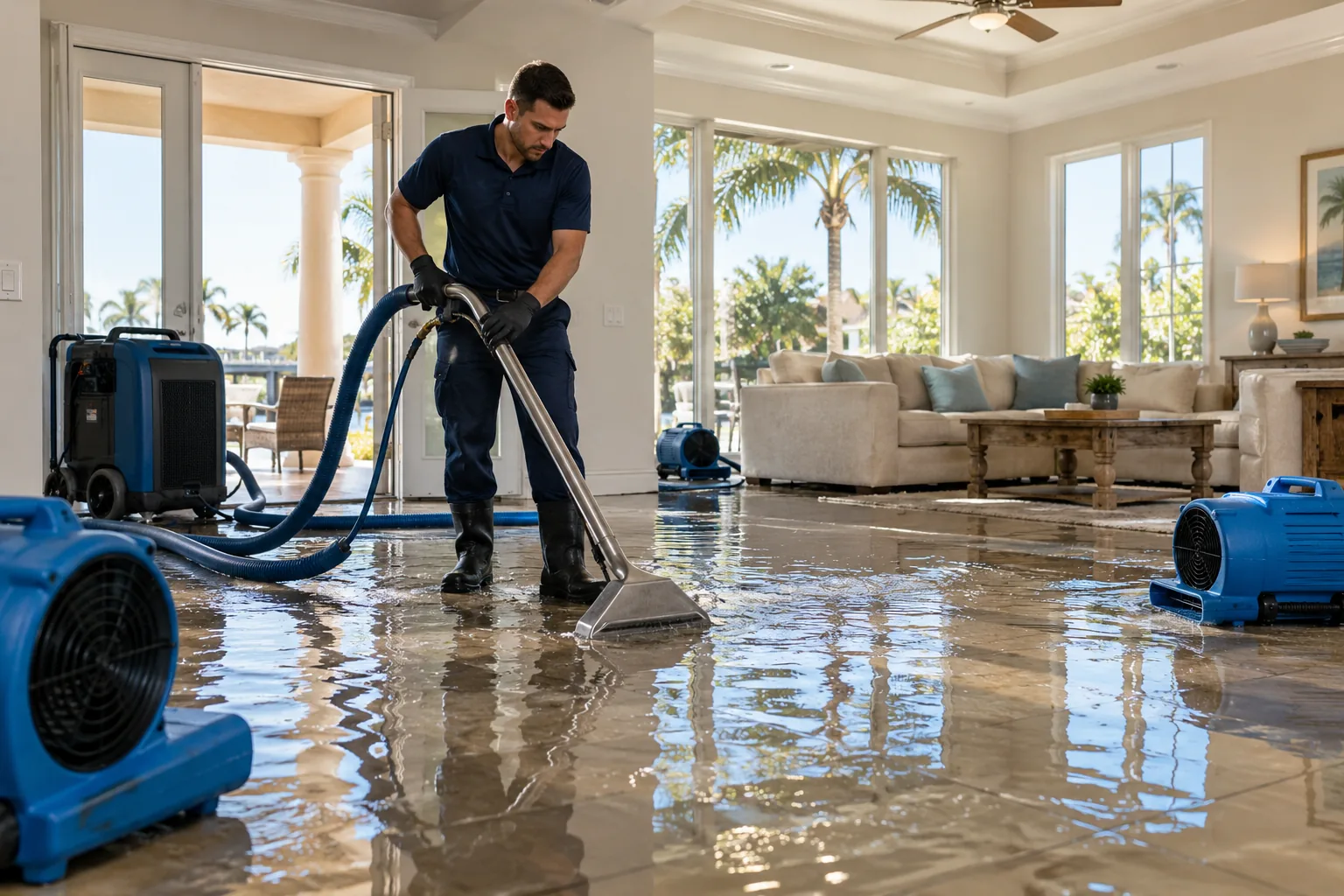
Water damage and mold remediation get mentioned in the same breath so often that people treat them as one job. They're not. Water restoration is about removing moisture; mold remediation is about removing contamination — and the order, methods, and even the legal requirements differ. Understanding the relationship saves you from paying for the wrong work.
How are water damage and mold connected?
The short answer: Mold needs three things: moisture, food (organic material like drywall paper or wood), and time. A water event supplies the moisture; your home supplies the food; and Florida's climate compresses the time to as little as 24–48 hours. Every mold problem starts as a moisture problem — which is why mold keeps coming back when only the mold is treated.
Think of it as cause and effect. The water intrusion is the cause; the mold colony is the effect. Remediation that removes mold but leaves the moisture source — the slow pipe drip, the roof leak, the unaddressed humidity — is landscaping the symptom while the disease continues. Conversely, thorough drying within the first day or two often prevents mold entirely, which is why rapid structural drying is also mold prevention.
What's the difference between water restoration and mold remediation?
The short answer: Water restoration removes water and dries the structure (extraction, dehumidification, moisture verification). Mold remediation removes contamination under containment (isolation barriers, negative air pressure, HEPA filtration, removal of colonized materials, antimicrobial treatment). Different goals, different equipment, different protocols.
| Water restoration | Mold remediation | |
|---|---|---|
| Goal | Return materials to dry standard | Remove mold contamination |
| Key equipment | Extractors, dehumidifiers, air movers, moisture meters | Containment, negative air machines, HEPA vacuums/filtration |
| Demolition | Only unsalvageable materials | All colonized porous materials |
| Verification | Moisture readings at dry standard | Visual + often third-party clearance testing |
| FL legal note | General contractor / restoration scope | Assessor and remediator must be independent |
What does Florida law require for mold work?
The short answer: Florida requires that mold assessment and mold remediation be performed by separate, independent parties — the company that determines the mold problem generally cannot be the one hired to fix it. This separation exists to prevent conflicts of interest (finding expensive problems to sell expensive solutions).
Practically, this means a proper Florida mold job has two vendors: a licensed mold assessor who inspects, tests, and writes the remediation protocol, and a licensed mold remediator who executes that protocol. Afterwards, the assessor (or another independent party) can verify clearance. If a single company offers to "test and treat" your mold in one visit, that's a red flag under Florida's framework — the assessment should be independent. This separation is one of the most consumer-protective features of Florida's system; use it.
Can I just dry it out and skip the mold remediation?
The short answer: If drying started within 24 hours and no mold is visible or suspected, often yes — thorough, verified drying prevents mold from establishing. But if materials stayed wet for several days, if there's visible growth, or if there's a musty odor, drying alone is insufficient: dead mold is still an allergen, and the contamination needs physical removal.
Two misconceptions to kill: "bleach kills mold so I can just spray it" — bleach doesn't penetrate porous materials and the water in bleach can feed the mold you're trying to kill; and "it's dry now so the mold is dead and harmless" — dead mold spores still trigger allergies and the staining/colonization remains. Remediation is physical removal under containment, not just killing. Our mold remediation service follows the assessment-then-remediation sequence Florida requires.
How do I know if my water damage has a mold problem too?
The short answer: Suspect mold when: the water sat for more than 48 hours, there's a musty or earthy odor, you see discoloration (black, green, white fuzzy growth) on or around wet areas, or occupants develop allergy-like symptoms (sneezing, congestion, itchy eyes) that improve away from the property.
Hidden mold is the trickier case — it's inside the wall, not on it. Musty odor with no visible growth is the classic sign. An independent mold assessor can confirm with moisture mapping, air or surface sampling, and cavity inspection. Don't rely on home test kits from the hardware store for decisions — they detect mold spores that exist in every home and don't tell you whether you have a problem. Professional assessment measures the right things in the right places. See our hidden water damage signs guide for the early warnings that precede mold.
Dealing with this right now?
You don't have to figure out the next step alone. Call and describe what you see — where the damage is, how long it's been there, and whether it's still spreading — and you'll get a straight answer about what to do next.
Call (833) 606-6010 Request help online
emergency line. If there's an active life-safety danger, call 911 first. Email: help@skyfoldrestorationfl.com
Frequently asked questions
Does insurance cover mold remediation in Florida?
Sometimes, with limits. Many Florida policies cap mold coverage (often around $10,000) or exclude it unless it results from a covered water event. Sudden pipe bursts that lead to mold are more likely covered than long-term leaks. Read your policy's mold provisions carefully and document the water event that caused it.
How long after water damage should I wait before worrying about mold?
Don't wait — in Florida, start worrying (and acting) within 24 hours. Professional drying within the first day or two usually prevents mold entirely. If you're past 48 hours with wet materials, include mold assessment in your plan.
Can mold come back after remediation?
Yes, if the moisture source returns. Remediation removes the contamination; it doesn't waterproof your home. Recurrence almost always traces to an unfixed leak, ongoing humidity problem, or new water event — which is why the moisture source must be resolved as part of the job.
Is black mold more dangerous than other mold?
"Black mold" (Stachybotrys) gets the headlines, but color doesn't determine hazard — many molds are dark, and health effects depend on species, concentration, and individual sensitivity. Any significant indoor mold growth deserves professional remediation regardless of color. Don't let anyone upsell you based on color alone.
Should I get mold testing before or after water damage cleanup?
If mold is suspected, assessment comes first — the assessor's protocol defines what the remediator should do. Testing after remediation (clearance verification) confirms the work succeeded. Testing in the middle, or by the remediation company itself, undermines the independence Florida's system is built on.
Can my AC spread mold through the house?
Yes — if mold is growing on the coil, in the drain pan, or in ductwork, the system distributes spores with every cycle. Musty odors that strengthen when the AC runs point to HVAC involvement. In that case, remediation should include the HVAC components, not just the rooms. See our air duct cleaning information.