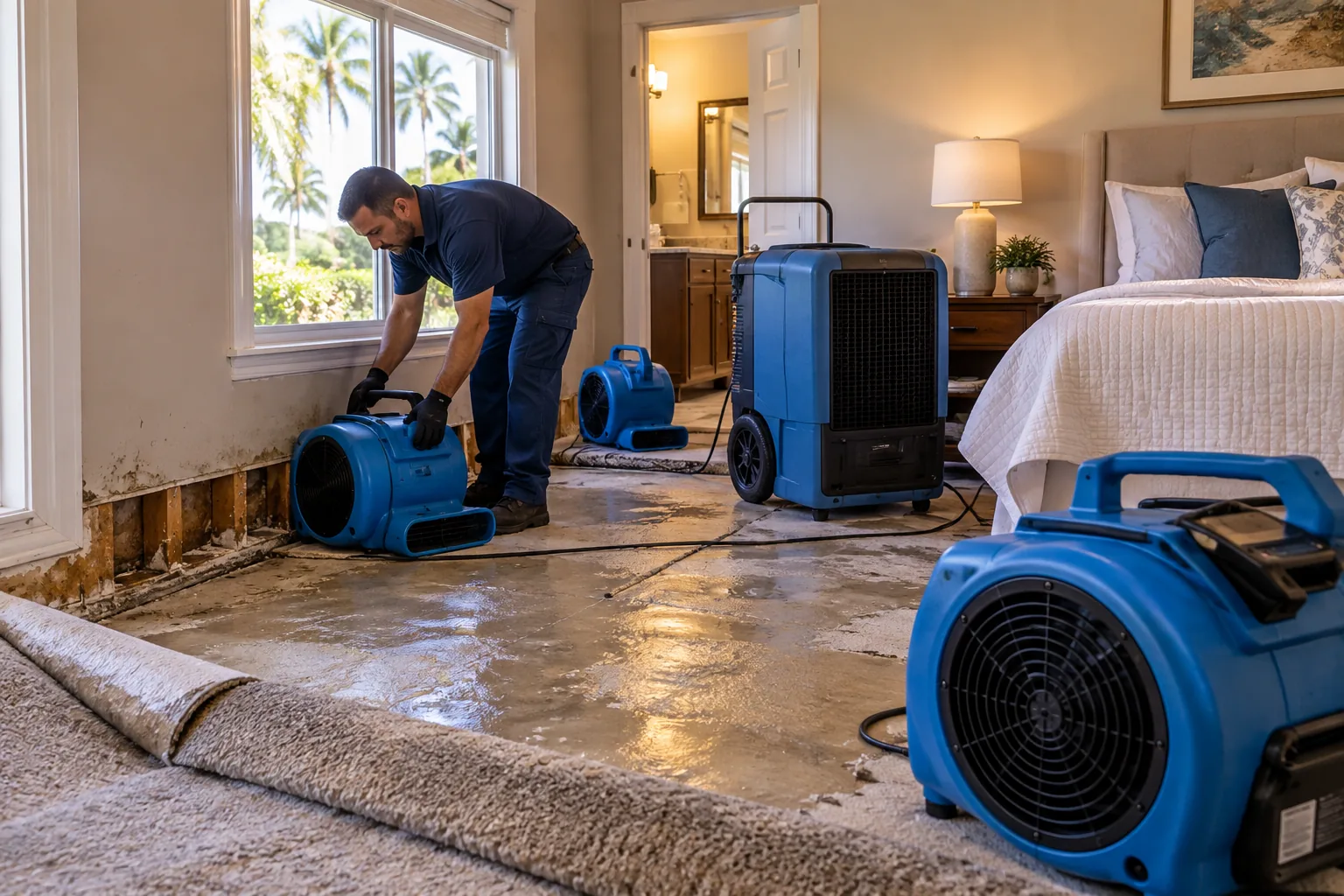
Air Duct & HVAC Cleaning in Florida
Your ductwork is the highway every contaminant travels. Professional HVAC cleaning removes mold, soot, dust, and allergens from ducts, coils, and air handlers — critical after fires, mold remediation, and in Florida’s year-round AC season.
Coverage entries describe the service-area directory and do not represent a physical office at every listed ZIP.
When Florida Homes Actually Need Duct Cleaning
Duct cleaning isn’t routine maintenance for every home — it’s targeted remediation for specific contamination. Here’s when it’s genuinely warranted:
After fire & smoke damage
If the HVAC ran during or after a fire, soot and smoke residues coat ductwork, coils, and the air handler. Cleaning the structure without cleaning the ducts means the first AC cycle re-distributes soot everywhere — duct cleaning is a mandatory phase of fire restoration, not an add-on.
Visible mold in the HVAC system
Musty odors from vents, visible growth on the evaporator coil or inside ductwork, or mold found during remediation. Florida’s humidity makes HVAC mold one of the state’s most common indoor air problems — condensate, dust, and darkness are all the colony needs.
Post-remediation verification
After mold remediation elsewhere in the home, duct cleaning ensures the system isn’t harboring spores that re-seed cleaned areas. It’s often the final step before clearance.
Renovation & construction dust
Drywall dust and debris infiltrate ductwork during remodels. Post-construction duct cleaning protects both the new finishes and your lungs.
Unexplained allergy symptoms
Dust mite debris, pollen, pet dander, and microbial growth accumulate in ducts over years. If symptoms spike when the AC runs and ease away from home, the duct system is a prime suspect — especially in Florida where the AC runs 9–12 months a year.
How Professional Duct Cleaning Works
NADCA (National Air Duct Cleaners Association) publishes the industry standard — ACR, Assessment, Cleaning & Restoration. Legitimate providers follow its principles; here’s what that looks like:
1. System assessment
The full HVAC system is inspected — ductwork, evaporator coil, blower, drain pan — with cameras where needed. You get a report of what was found, not just a cleaning bill.
2. Containment & negative pressure
The system is placed under negative pressure with HEPA-filtered collection equipment. Dislodged contaminants are pulled into containment — not blown into your living space.
3. Agitation & extraction
Rotary brushes, compressed-air tools, and contact vacuuming dislodge debris from duct walls while the negative-air system extracts it. Every supply and return run is addressed, not just the easy ones.
4. Coil, blower & drain pan
The evaporator coil (Florida’s mold hotspot), blower assembly, and condensate drain pan are cleaned — the components that actually touch your air and water.
5. Antimicrobial treatment (when warranted)
EPA-registered antimicrobials are applied to non-porous components when microbial contamination was found — never as a substitute for physical removal.
6. Verification
Post-cleaning inspection — visual and camera — confirms the work. Before/after documentation goes into your file.
Air Duct Cleaning Cost in Florida
Typical range: $300–$800 for a residential system in Florida, depending on system size, number of vents, contamination level, and whether coil and blower cleaning are included. Post-fire soot decontamination and mold-involved cleaning run higher ($600–$1,200+) because they require containment, HEPA protocols, and antimicrobial treatment.
What’s not legitimate: the infamous $99 whole-house special. Real duct cleaning takes 3–5 hours with thousands of dollars of equipment — $99 buys a bait-and-switch where the ‘technician’ discovers urgent problems requiring hundreds more. Florida’s consumer protection laws apply; legitimate providers quote transparently after asking about your system, not before seeing it.
Why Ductwork Matters More in Florida
Florida homes run their air conditioning nearly year-round, which means ductwork here works harder and stays damper than in any other state. Condensate on evaporator coils, dust-fed microbial growth in dark ducts, and humidity-driven musty odors are Florida signatures — not exceptions. Add hurricane-season moisture intrusion and the state’s love of attic air handlers (where heat and humidity concentrate), and HVAC hygiene becomes a genuine health and home-durability issue, not a luxury.
After any mold remediation, fire restoration, or major water loss, treat duct cleaning as part of the project scope — not a separate decision. Contaminated ducts re-contaminate clean rooms; it’s building science, not upselling.
How to Spot Duct-Cleaning Scams
Bait pricing
$99–$149 ‘whole house’ offers are the classic hook. Real cleaning costs real money — the cheap quote exists to get a salesperson inside your home.
No system questions
A legitimate provider asks about your system size, vent count, and contamination concerns before quoting. A flat price with zero questions is a sales script, not a service.
Mold ‘found’ in minutes
Scare tactics: a quick vent peek followed by alarming mold claims and a quadrupled price. Real mold assessment takes inspection — and in Florida, assessment and remediation must be separate roles.
No NADCA alignment
Ask what standard they follow. NADCA’s ACR standard is the industry benchmark — providers who can’t name a standard are telling you everything.
Duct Cleaning vs. Duct Replacement: How to Decide
Sometimes cleaning isn’t the answer. Clean when ductwork is structurally sound with removable contamination — dust, soot, light microbial growth on non-porous surfaces. Replace when ducts are rusted through, saturated with sewage or floodwater, lined with deteriorating fiberglass that sheds fibers, or so extensively mold-colonized that remediation can’t verify clearance. Flexible ductwork crushed or kinked in hot Florida attics often cleans poorly and replaces cheaply — an honest provider tells you which you have.
After floodwater intrusion into ductwork, replacement is usually the call: floodwater is Category 3 black water, and porous duct materials can’t be reliably decontaminated. After fire, cleaning usually suffices unless heat damaged the ducts themselves. A provider who only sells cleaning — or only sells replacement — is selling inventory, not advice.
What a Proper Duct-Cleaning Quote Includes
Compare quotes on these lines, not just the total:
System inventory
Number of supply and return vents, system tonnage, accessible vs. inaccessible runs. A quote without a vent count is a guess.
Components covered
Ductwork alone, or also evaporator coil, blower, and drain pan? Coil cleaning is where Florida mold actually lives — a ‘duct cleaning’ that skips the coil misses the problem.
Method specified
Negative-pressure HEPA collection plus mechanical agitation (brushes/air tools). ‘Blow-and-go’ compressed-air-only jobs without containment just redistribute dust.
Antimicrobial terms
Which EPA-registered product, applied where, and why — or an explicit statement that none is needed. Vague ‘sanitizing’ language is a red flag.
Documentation
Before/after camera inspection included. Without it, you’re paying for a promise, not a result.
Keeping Ducts Clean After the Service
Cleaning is a reset, not a permanent fix. In Florida: change filters on schedule — every 1–3 months with year-round AC use, and use the MERV rating your system is designed for (too-high MERV strains blowers); keep condensate drains clear — annual HVAC maintenance with drain-line clearing prevents the moisture that grows coil mold; seal duct leaks — leaky returns in hot attics pull in dust and humidity that re-contaminate clean ducts; control indoor humidity — keep it under 60% (under 50% is better) with right-sized AC and supplemental dehumidification where needed; and address the source — if mold was the reason for cleaning, the moisture source repair matters more than the cleaning itself. Re-inspect every 2–3 years; re-clean only when inspection shows contamination.
Air Duct & HVAC Cleaning in Florida: Common Questions
How much does air duct cleaning cost in Florida?
Typically $300–$800 for a residential system. Post-fire soot decontamination or mold-involved cleaning runs $600–$1,200+ due to containment and HEPA protocols. Beware $99 whole-house offers — they’re bait-and-switch setups.
How often should air ducts be cleaned in Florida?
Not on a fixed schedule — when contamination warrants it: after fires, mold remediation, renovations, or when symptoms point to the system. Florida’s year-round AC use means inspection every 2–3 years is reasonable; cleaning only when found dirty.
Can mold grow in air ducts?
Yes — it’s one of Florida’s most common HVAC problems. Dust plus condensate moisture on coils and in drain pans grows mold readily. Musty odors when the AC runs are the classic symptom.
Is duct cleaning necessary after a fire?
If the HVAC operated during or after the fire, yes — soot coats ductwork and coils, and the first post-restoration AC cycle redistributes it. It’s a standard phase of fire restoration.
What is NADCA?
The National Air Duct Cleaners Association — the industry body publishing the ACR standard for HVAC assessment, cleaning, and restoration. It’s the benchmark legitimate providers align with.
Will duct cleaning help with allergies?
If the duct system harbors dust, dander, pollen, or microbial growth — common in Florida — cleaning removes that reservoir. It won’t fix allergies caused by outdoor pollen or other sources, and honest providers say so.
Related Services & Resources
Get Help Now — Emergency Line
Active damage can’t wait. Call (833) 606-6010 or request a callback — we’ll talk through your situation and next steps.