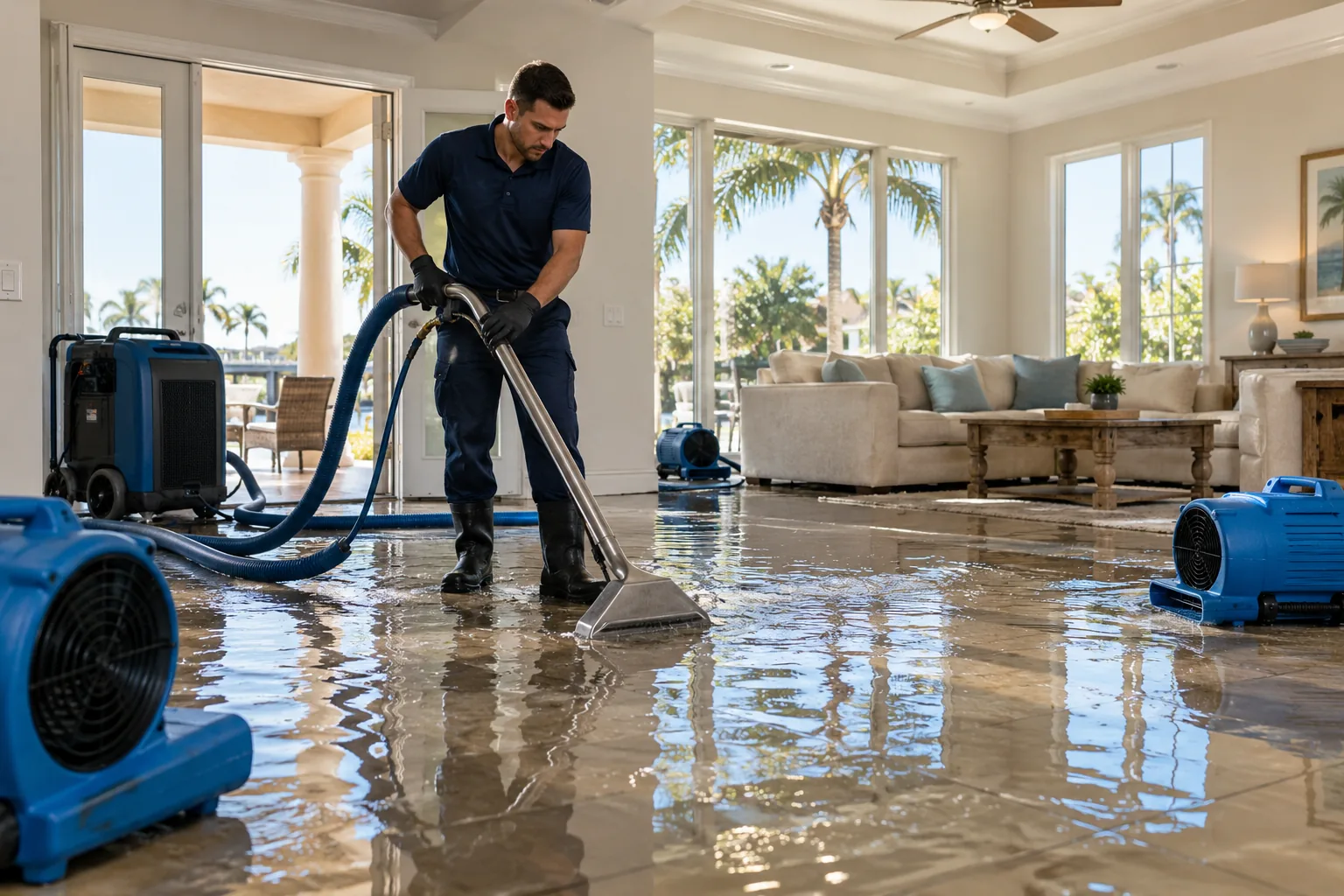
Water sitting on your floor is annoying. Water trapped under your floor is destructive. Once moisture gets beneath the surface — under planks, tiles, or carpet — it's sealed in a dark, warm sandwich with the subfloor, where it can't evaporate and where mold and rot thrive. Here's how to tell it's happening, what can be saved, and what the recovery process looks like.
How does water get under flooring in the first place?
The short answer: Through the paths of least resistance: seams between planks or tiles, edges where flooring meets walls, under baseboards, through grout lines, and via wicking from an adjacent wet area. It also comes from below — slab moisture wicking upward, or leaks in the subfloor cavity from plumbing beneath.
People picture water damage as water falling onto a floor. But some of the worst under-floor damage comes sideways and upward: a dishwasher supply line dripping for weeks sends water under the kitchen tile edge; a slab leak pushes moisture up through the concrete; an AC condensate overflow in an upstairs closet rains into the ceiling cavity and soaks the floor above from beneath. By the time the surface shows symptoms, the underside has been wet far longer.
Which types of flooring can be saved after water damage?
The short answer: Tile and concrete floors usually survive with thorough drying of what's beneath them. Hardwood can often be saved with specialized drying mats if addressed within 24–48 hours. Carpet can sometimes be saved but the pad almost always gets replaced. Laminate and engineered wood with swollen cores are generally not salvageable.
| Flooring type | Salvage outlook | What decides it |
|---|---|---|
| Ceramic/porcelain tile | Usually saved | Grout and thinset must be dried; check for hollow tiles |
| Solid hardwood | Often saved if fast | Drying mats + time; cupping often flattens as it dries |
| Engineered wood | Sometimes | Depends on core swelling and veneer delamination |
| Laminate | Rarely | Fiberboard core swells irreversibly |
| Carpet | Sometimes | Clean water + fast action; pad is replaced regardless |
| Luxury vinyl plank | Often saved | Waterproof surface, but trapped water beneath must be dried |
What are the signs of water trapped under a floor?
The short answer: Look for cupping or crowning in wood floors, buckling or tenting in laminate and vinyl, hollow or drummy sounds when tapping tile, spongy or uneven spots in carpet, musty odors with no visible source, and baseboards that are staining or pulling away from the wall.
The tap test is surprisingly useful on tile: walk the floor tapping with a knuckle or coin. Solid, well-bonded tile sounds sharp; tile with moisture-compromised thinset underneath sounds hollow. On wood, cupping — edges higher than the center of each board — is the classic early sign. One caution: cupping can partially reverse as the floor dries, so don't rush to sand or replace cupped hardwood until drying is complete and verified. Premature sanding of a cupped floor causes crowning (the reverse problem) that's much harder to fix.
What does professional under-floor drying involve?
The short answer: Moisture mapping first (meters and thermal imaging to find the full extent), then targeted drying: hardwood floor drying mats that pull moisture through the surface, injection drying that forces dry air into cavities beneath, dehumidification to handle the released moisture, and daily meter readings until the subfloor hits its dry standard.
This is specialized work — a box fan in the room does essentially nothing for water trapped under flooring. Drying mats seal against the wood surface and create negative pressure that draws moisture up through the boards. For tile, technicians may drill tiny grout-line access points for injection drying, or tent the area to concentrate dehumidified air. The process takes days, not hours, and rushing it (especially with heat) can crack wood and pop tiles. Patience plus measurement is the whole game. Learn more about structural drying methods.
When does flooring have to be removed instead of dried?
The short answer: Removal is necessary when the material is structurally compromised (crumbling laminate core, delaminated engineered wood), when contamination is involved (sewage under flooring can never be adequately sanitized in place), when mold has colonized the underside or subfloor, or when drying readings stall and won't reach the dry standard.
Here's the reframe that helps: the goal isn't saving the floor, it's eliminating the moisture problem. A beautifully dried hardwood surface over a moldy subfloor is a failure. Professionals check both — surface meters for the flooring, pin probes through to the subfloor. If the subfloor needs replacement, the flooring comes up regardless of its condition. It's also worth knowing that insurance typically covers the necessary scope: if drying in place is viable, that's what's approved; if removal is required, that is. Documentation of moisture readings is what justifies either path to an adjuster — see our insurance documentation guide.
Dealing with this right now?
You don't have to figure out the next step alone. Call and describe what you see — where the water is, how long it's been there, and whether it's still spreading — and you'll get a straight answer about what to do next.
Call (833) 606-6010 Request help online
emergency line. If there's an active life-safety danger, call 911 first. Email: help@skyfoldrestorationfl.com
Frequently asked questions
How long can water sit under flooring before it's a serious problem?
Damage begins within hours for vulnerable materials like laminate and carpet pad. Hardwood tolerates 24–48 hours reasonably well if drying starts promptly. Beyond 72 hours, expect mold risk, adhesive failure, and subfloor damage to rise sharply — especially in Florida's humidity.
Will my wood floors go back to normal after drying?
Often, yes — cupping frequently flattens as moisture leaves, though it can take weeks after drying completes. Don't sand or refinish until the floor has stabilized at normal moisture for at least a couple of weeks, or you'll create new problems.
Can water under tile cause mold?
Yes. While tile itself doesn't feed mold, the thinset, grout, and especially any organic material beneath (wood subfloor, drywall) do. Hollow-sounding tiles with musty odors deserve investigation, not just regrouting.
Is a wet carpet pad always replaced?
Almost always. Carpet pad is cheap, absorbent, and nearly impossible to fully dry and sanitize in place. Replacing the pad while saving the carpet is standard practice for clean-water events — and it's far less expensive than most owners expect.
What if the water came from sewage?
Then the calculus changes completely: porous flooring (carpet, pad, laminate, hardwood) exposed to Category 3 black water is removed, not dried. Tile may be salvageable after professional sanitization. See our sewage backup guide for the full protocol.
How do I know the subfloor is dry enough?
Pin meter readings compared against a dry standard from unaffected wood in the same home — typically targeting the 10–12% range for wood, varying by species and region. Your contractor should show you the readings, not just declare it dry.