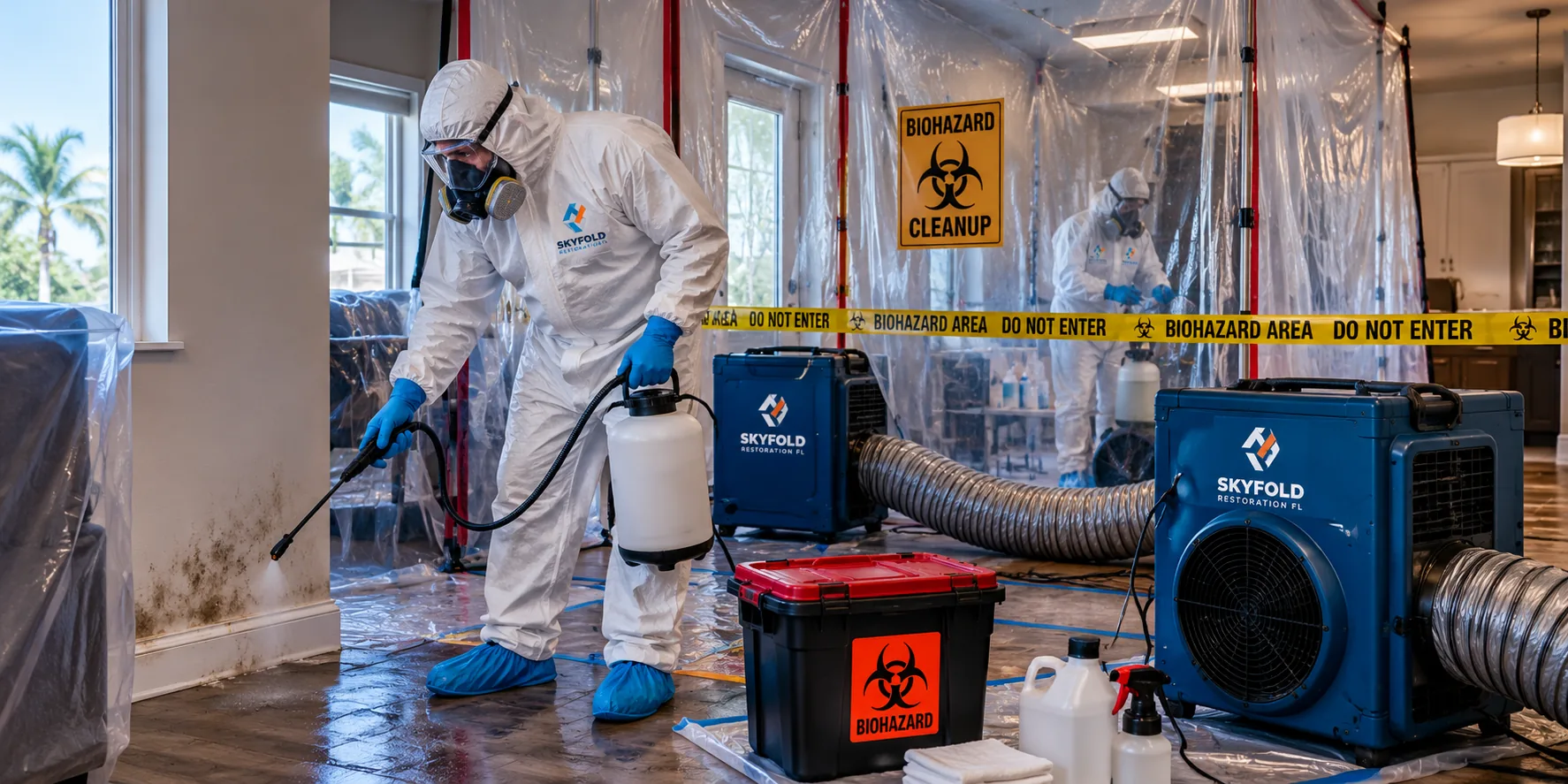
Biohazard cleanup is the restoration work nobody wants to think about until they need it — and then they need to understand it fast, often while grieving or in shock. This guide explains what professional biohazard remediation actually involves, step by step, so you know what to expect and what proper service looks like.
What happens during professional biohazard cleanup?
The short answer: A trained team assesses the scene, contains the affected area to prevent cross-contamination, removes all biohazardous materials (including porous building materials that can't be disinfected), cleans and disinfects remaining surfaces with hospital-grade agents, deodorizes, verifies the work, and arranges regulated disposal of all waste. Personal property is treated with the same care as the structure.
The defining feature is protocol. Every step exists because bloodborne pathogens (hepatitis B and C, HIV, MRSA, and others) survive on surfaces and require specific contact times, concentrations, and methods to neutralize. This isn't "cleaning really well" — it's a decontamination procedure with verification. Our biohazard cleanup service follows this full sequence on every job.
The seven phases
- Assessment: The team evaluates the extent — what fluids are present, what materials are affected, what the disposal and remediation scope will be. If law enforcement is involved, coordination happens here; cleanup typically begins after release of the scene.
- Containment: Physical barriers and negative air pressure isolate the work zone so contaminants don't migrate to clean areas. (More on why this matters in our containment guide.)
- Removal: All biohazardous material — including carpet, pad, drywall sections, and furnishings that absorbed fluids — is removed and bagged as regulated waste. Porous materials are never "disinfected in place."
- Cleaning: Remaining hard surfaces are cleaned of all visible contamination. You can't disinfect what isn't clean — organic matter shields pathogens from disinfectants.
- Disinfection: EPA-registered hospital-grade disinfectants applied at proper concentrations with required dwell times. This is chemistry with a clock, not spraying and wiping.
- Deodorization: Hydroxyl or other appropriate treatment for residual odor — because a space that looks clean but smells wrong isn't restored.
- Verification and disposal: Final inspection, ATP testing or visual verification depending on scope, and all waste transported to licensed medical waste disposal. Documentation provided.
Why can't I just clean it up myself?
The short answer: Three reasons: health risk (bloodborne pathogens infect through microscopic skin breaks and mucous membranes — household cleaning doesn't achieve decontamination), legal risk (biohazardous waste disposal is regulated — it can't go in household trash), and the human cost (asking grieving family to scrub a scene is a trauma that lasts).
People underestimate the first and overestimate their protection. Latex gloves and bleach are not a biohazard protocol — they don't address aerosolized particles, they don't achieve required disinfectant contact times, and they leave contamination in porous materials that looks clean but isn't. Professionals wear full PPE including respirators for a reason. And Florida's heat accelerates decomposition, which intensifies both the biological hazard and the odor — speed matters, but safe speed, by trained people.
How is biohazard waste disposed of?
The short answer: As regulated medical waste: bagged in labeled biohazard containers, transported by licensed carriers, and treated (typically autoclaved or incinerated) at permitted facilities. It never goes in dumpsters, household trash, or standard landfills — that's illegal and dangerous.
The chain of custody matters: from your property to final treatment, the waste is tracked. Reputable companies provide documentation of proper disposal — ask for it. This protects you legally as the property owner or manager, because improper disposal liability can follow the waste back to its source. If a "cleanup" quote seems suspiciously cheap, ask exactly how waste is handled; corner-cutting usually starts there.
What about the emotional side — how do companies handle that?
The short answer: With deliberate discretion and compassion: unmarked vehicles on request, no uniforms that advertise the nature of the work to neighbors, direct and honest communication without euphemism or sensationalism, and coordination that minimizes the family's need to be present or make decisions under duress.
This is part of the job, not a bonus. The best biohazard teams understand they're entering someone's worst day. Practical compassion looks like: handling everything so the family doesn't have to, communicating clearly about what's happening and what happens next, working efficiently to shorten the ordeal, and treating personal property with visible respect. If you're arranging this for a loved one, know that you don't need to be strong enough to do it yourself — that's what the service is for. Call (833) 606-6010 any time; the call itself is handled with discretion.
How long does biohazard cleanup take?
The short answer: Most residential scenes are completed in one to three days: assessment and containment on day one, removal and decontamination following, with verification at the end. Larger commercial scenes, hoarding situations, or cases involving significant structural removal take longer.
Timeline factors: the extent of fluid migration (bodily fluids wick surprisingly far into porous materials), whether structural materials need removal, coordination with law enforcement or coroners (which can delay start), and the deodorization phase, which sometimes needs extended treatment. A reputable company gives you an honest timeline after assessment — beware anyone who quotes duration without seeing the scene.
Dealing with this right now?
You don't have to figure out the next step alone. Call and describe the situation — what happened, where, and whether the area is secured — and you'll get a straight answer about what to do next. All inquiries are handled discreetly.
Call (833) 606-6010 Request help online
emergency line answered with discretion. If there's an active life-safety danger, call 911 first. Email: help@skyfoldrestorationfl.com
Frequently asked questions
Does homeowners insurance cover biohazard cleanup?
Often yes — many policies cover biohazard remediation under the main dwelling coverage, and some situations involve victim compensation funds or employer liability. Coverage varies widely; document everything and check your policy. Our financing guide covers options when coverage is unclear or delayed.
Will my neighbors know what's happening?
Not from a discreet company. Reputable firms offer unmarked vehicles, plain work clothing, and contained work practices specifically to protect your privacy. You can request the level of discretion you're comfortable with.
Can personal belongings be saved?
Hard, non-porous items often can be decontaminated. Porous items (mattresses, upholstered furniture, carpet) exposed to biological material generally cannot be made safe and are removed. The team will go through this with you item by item — nothing is discarded without your knowledge.
What if the death was undiscovered for days?
Decomposition intensifies everything: odor, fluid migration, and structural absorption. These scenes need more extensive material removal and longer deodorization, but they're absolutely remediable. Florida's heat accelerates the timeline, so call as soon as the situation is known.
Do I need to be present during cleanup?
No — and most families prefer not to be. You (or your designated representative) need to authorize the scope and handle decisions about personal property, but the work itself doesn't require your presence. Many clients hand over keys and return to a restored space.
How do I verify the cleanup was done properly?
Ask for: the scope documentation (what was removed, what was treated), disinfectant products and methods used, waste disposal manifests, and post-remediation verification. A company that can't produce these didn't do verifiable work.