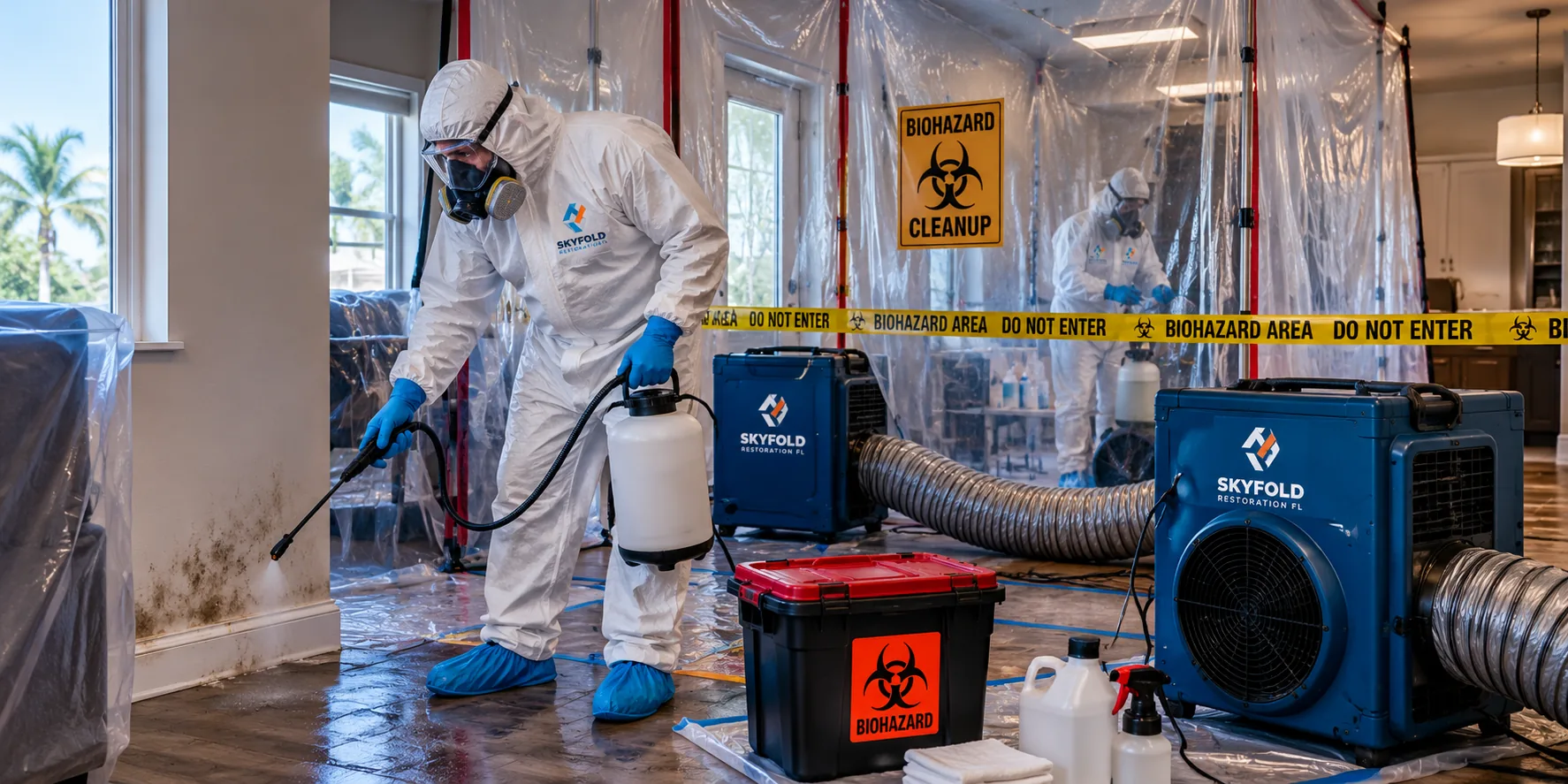
It's the least visible part of biohazard cleanup — plastic sheeting, zippered doorways, humming machines — and the most important. Containment is what keeps a contained problem from becoming a building-wide problem. Here's why professionals treat it as non-negotiable, and what proper containment looks like.
What is containment in biohazard cleanup?
The short answer: The physical isolation of the contaminated area from the rest of the building using sealed polyethylene barriers, taped seams, covered vents and openings, a controlled entry/exit point, and negative air pressure machines with HEPA filtration that ensure air flows into (never out of) the work zone.
Think of it as a room within a room, with its own air management. The barriers block the obvious paths (doorways, hallways); the negative air pressure handles the invisible ones — every gap, every seam, every moment a worker enters or exits. Without the pressure differential, barriers alone are just plastic: air (and everything in it) moves freely around edges and through openings. With it, physics does the containment work continuously, even when people are moving through the entry point.
Why does containment matter so much?
The short answer: Because remediation is inherently disruptive — cutting drywall, pulling carpet, bagging waste all release particles, aerosols, and odor into the air. Without containment, that contamination migrates through the building via air currents, the HVAC system, and foot traffic, turning a one-room problem into a whole-building problem.
The math is unforgiving: a biohazard scene contained to one bedroom needs that bedroom remediated. The same scene worked without containment can contaminate the hallway, adjacent rooms, and the HVAC system — each now needing assessment and possibly remediation. Containment doesn't just protect health; it protects the scope, keeping the job (and its cost) as small as the actual problem. It's also a regulatory expectation: OSHA's bloodborne pathogen standards and industry protocols assume controlled work areas, not open demolition.
What containment protects
- The rest of the building: clean rooms stay clean; the remediation footprint stays limited to the actual contamination.
- Occupants: family members, employees, or tenants in adjacent spaces aren't exposed to work-zone aerosols.
- Workers: the controlled zone concentrates PPE protocols and decontamination procedures at the entry point.
- The HVAC system: sealed vents plus negative pressure keep contamination out of ductwork — because HVAC contamination multiplies every problem (see our odor guide).
- The verification: a contained zone can be verified clean with confidence; an uncontained building can't.
What does proper containment look like?
The short answer: Floor-to-ceiling polyethylene sheeting sealed at all edges, a zippered or flap entry with a transition area, all HVAC vents and openings in the zone sealed, a negative air machine sized to the space exhausting through HEPA filtration to the outside (or scrubbed recirculation), and visible inward billowing of the sheeting confirming negative pressure.
That last detail is your field check: stand outside the containment and look at the plastic — it should bow inward, showing air is being pulled into the zone. If it billows outward or hangs flat, the negative pressure isn't working. Also expect: workers donning/doffing PPE at the entry point (not in your hallway), waste bagged and sealed inside the zone before transport, and tools decontaminated at the boundary. These aren't extras — they're the visible evidence of a real protocol. Our biohazard cleanup process includes containment as a defined phase on every job.
Is containment used in other restoration work too?
The short answer: Yes — the same principles apply to mold remediation (containing spores during removal), fire/soot cleanup (containing fine particulates), and sewage cleanup (containing contaminants and odor). Any remediation that disturbs contamination uses containment; it's a universal best practice, not a biohazard exclusive.
The details vary by hazard — mold containment focuses on spore control, fire containment on fine particulate — but the physics is identical: isolate, pressurize negative, filter exhaust, control entry. When evaluating any remediation contractor, "walk me through your containment plan" is one of the most revealing questions you can ask. A specific, confident answer indicates real protocol; vagueness indicates the opposite.
Dealing with this right now?
You don't have to figure out the next step alone. Call and describe the situation — what happened, where, and whether the area is secured — and you'll get a straight answer about what to do next. All inquiries are handled discreetly.
Call (833) 606-6010 Request help online
emergency line answered with discretion. If there's an active life-safety danger, call 911 first. Email: help@skyfoldrestorationfl.com
Frequently asked questions
Can I stay in the house during biohazard cleanup?
Often yes for other areas of the home, precisely because of containment — the work zone is isolated from living spaces. Your contractor will advise based on the layout; in small homes where isolation isn't practical, temporary relocation may be recommended.
How is negative air pressure created?
With a negative air machine — essentially a powerful HEPA-filtered exhaust fan that pulls air out of the contained zone faster than it can leak back in, creating inward airflow at every gap. The exhaust goes outside or through HEPA filtration. Manometers or simple visual checks (inward-billowing plastic) confirm it's working.
Does containment make the job take longer?
Slightly — setup takes time. But it prevents the scope expansion that makes uncontained jobs take far longer overall. Net effect: containment shortens total project time by keeping the problem small.
What happens to the containment materials afterward?
They're treated as potentially contaminated: carefully removed, bagged, and disposed of with the regulated waste stream. The barriers did their job by catching what would otherwise have migrated — they're not reused.
Is containment required by law?
OSHA bloodborne pathogen standards require work practice controls that effectively mandate controlled work areas for occupational exposure; industry standards (IICRC S540 for trauma scenes, S520 for mold) specify containment procedures. Whether or not a specific statute says "containment," operating without it falls below the professional standard of care.