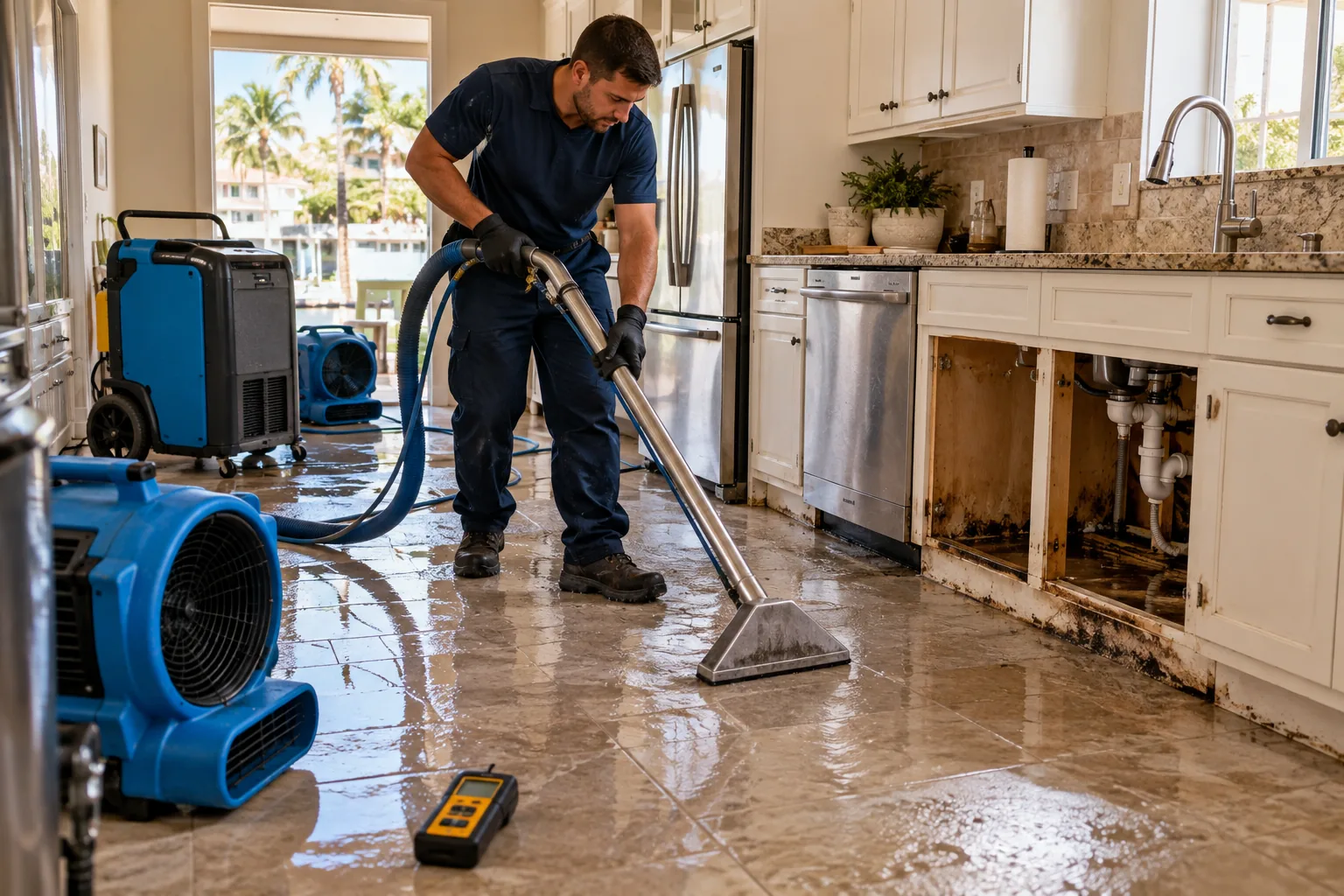
Water Removal in Florida
Water removal focuses on removing accessible water so the property can move into drying and moisture-control work.
Coverage entries describe the service-area directory and do not represent a physical office at every listed ZIP.
Water removal is the first physical step after many leaks and floods
Water can move through flooring, baseboards, cabinetry and lower wall areas quickly. Removing standing water reduces the amount of free water available to spread, but it does not by itself prove the structure is dry.
The right approach depends on the amount of water, its source, the affected materials and whether contamination is involved.
Where water can hide
Under flooring
Water may collect below finished surfaces or in padding and underlayment.
Behind walls and cabinets
Moisture can travel beyond the visible edge of a leak.
Contents and furniture
Soft goods and porous contents may retain moisture after surface water is gone.
Low areas and transitions
Thresholds, baseboards and floor joints can hold moisture longer than open surfaces.
Water removal vs. structural drying
Extraction removes free-standing water. Structural drying manages the moisture that remains in materials and the indoor environment. Both matter when water has reached absorbent building components.
Moisture checks help distinguish a property that looks dry from one that has reached a more stable condition.
Questions property owners should ask
- What is the water source?
- Which materials are wet?
- Could moisture be hidden below or behind finishes?
- How will drying be monitored?
- What documentation will be kept?
Related restoration services
Water Damage Restoration
Explore the related water damage restoration service and how it connects to the restoration process.
Water Extraction & Removal
Explore the related water extraction & removal service and how it connects to the restoration process.
Structural Drying
Explore the related structural drying service and how it connects to the restoration process.
Flood Damage Cleanup
Explore the related flood damage cleanup service and how it connects to the restoration process.
Insurance Documentation Support
Explore the related insurance documentation support service and how it connects to the restoration process.
Need to talk through a property loss?
Give the city, ZIP code and damage type when you call. For immediate life-safety emergencies, contact 911 first.
Situations That Need Emergency Water Removal Now
Spotting these early is the difference between a quick mitigation and a major restoration. If you see any of them, call (833) 606-6010.
Standing water across any floor
Any standing water — an inch or a foot — is an emergency in Florida. Every hour feeds wicking, humidity, and the 48-hour mold clock.
Water near electrical systems
Water around outlets, panels, or appliances is a safety emergency first: don’t enter, cut power if safe, and call for professional removal.
Sewage or floodwater intrusion
Category 3 black water needs professional containment and removal immediately — not mopping, not waiting, not DIY.
Water spreading while you watch
An active, spreading source (burst pipe, failed appliance, storm intrusion) outruns towels and wet-vacs. Professional extraction capacity is measured in hundreds of gallons per hour.
Water in a vacant or rental property
Discovered late, already spreading, and nobody on-site to monitor — vacant-property water losses deteriorate fastest and need immediate professional response.
Water Removal Questions
What’s the difference between water removal and water extraction?
They’re closely related — removal is the emergency phase (get standing water out now), extraction is the method. Both feed into structural drying and full restoration.
How quickly can emergency water removal respond in Florida?
Reputable emergency services target arrival within 60–90 minutes in metro areas. For active flooding, call immediately — don’t wait for business hours.
Will my insurance cover emergency water removal?
If the loss is a covered peril (sudden and accidental), emergency mitigation like water removal is typically covered — and insurers expect you to mitigate promptly. Document everything.
What happens if water sits for more than 48 hours?
In Florida, mold growth often begins within 24–48 hours. Sitting water also wicks higher into drywall, swells wood, and corrodes metals — multiplying the final scope and cost.
What Affects Water Removal Cost in Florida?
Emergency water removal in Florida typically runs $250 to $1,500 for the removal visit, scaling with volume, contamination level, and how far the water spread. Like extraction, it’s usually the opening phase of a full restoration scope.
Volume standing
A single-room appliance leak vs. inches across a ground floor — volume is the primary cost driver for the removal visit.
Contamination category
Category 1 clean water is cheapest. Category 3 black water (sewage, floodwater) triggers containment, PPE, and disposal costs.
Materials affected
Water over tile removes fast. Water under hardwood, laminate, or into wall cavities needs specialty tools and more labor hours.
After-hours response
2 a.m. emergency calls carry after-hours rates — but waiting until morning in Florida humidity almost always costs more in secondary damage.
How Water Removal Works, Step by Step
Water removal is the emergency phase: get the water out now, verify what remains, and set up drying before humidity does its damage.
1. Rapid assessment
The water source, category (clean/gray/black), affected areas, and safety hazards — electrical, structural, contamination — are identified on arrival.
2. Bulk water removal
High-volume pumps and truck-mounted extractors clear standing water. Submersible pumps handle depths that extractors can’t.
3. Detail extraction
Weighted tools on carpet, squeegees on hard floors, and crevice tools along baseboards capture what bulk removal leaves.
4. Moisture mapping
Meters and thermal imaging find water that migrated behind walls and under flooring — the hidden moisture that causes mold weeks later.
5. Drying setup
Air movers and dehumidifiers go in immediately, positioned by psychrometric readings — not by guesswork.
Emergency Water Removal in Florida: Why Hours Matter
In Florida, water removal is a race against humidity. Indoor air already holds heavy moisture; standing water evaporates into it, and within a day you can have condensation forming on cool surfaces — effectively a second water event. Fast removal breaks that cycle.
The most common Florida water removal calls: burst washing machine hoses, water heater failures, AC drain pan overflows, slab leaks, and storm intrusion. Slab-on-grade construction — standard across Florida — means water spreads wide and fast with nowhere to drain, making rapid removal even more critical.
Emergency
Active water removal in Florida? Call (833) 606-6010 now — fast response limits secondary damage.
Related Restoration Services
Damage rarely involves just one trade. These services commonly connect to water removal projects.