Fire & Smoke Damage FAQs
Fire & Smoke Damage FAQs for Florida property owners. Clear answers about safety, emergency steps, cleanup, drying, documentation and restoration planning.
Coverage entries describe the service-area directory and do not represent a physical office at every listed ZIP.
Fire & Smoke Damage FAQs
Clear answers about fire and smoke damage restoration — what happens after the fire department leaves, how smoke damage works, what can be saved, and how the claim process goes.
What should I do right after a fire?
The short answer: Once the fire department releases the scene: secure the property (board-up, tarping), document all damage before anything is moved, contact your insurer, and arrange professional assessment. Don't start cleaning or throwing things away — soot-damaged items may be restorable, and everything is claim evidence until inventoried.
The emotional impulse is to start clearing the mess. Resist it for the first day: every item removed without documentation weakens the contents claim, and improper cleaning (water on soot, household cleaners on protein residue) can set damage permanently. The correct first-day actions are security, documentation, and professional assessment — cleanup follows the plan, not the impulse.
How far does smoke damage actually reach?
The short answer: Throughout the building. Heat pressure and air currents drive smoke through open doors, up stairwells, into wall cavities, and through the HVAC system into every served room. It's normal for untouched rooms two floors away to need soot cleaning and deodorization.
This is why fire restoration scopes surprise owners — the burned kitchen is obvious, but the real scope includes the whole building's soft goods, the HVAC system, and wall cavities. Keep the HVAC off until inspected; running it redistributes soot everywhere. Our smoke and soot guide explains the science and the remediation.
What about the water the firefighters used?
The short answer: It's a major secondary problem: thousands of gallons soaking through floors below the fire, contaminated with soot and chemicals. It needs extraction and structural drying in parallel with fire remediation — not afterward. And it's part of your fire insurance claim, not a separate event.
The sequencing error to avoid: treating water as the "later" problem. Mold grows on wet materials regardless of why they're wet, and soot-plus-water is corrosive. A proper fire response runs both scopes simultaneously. See our firefighting water guide for the full picture.
Why smoke damage spreads farther than the fire
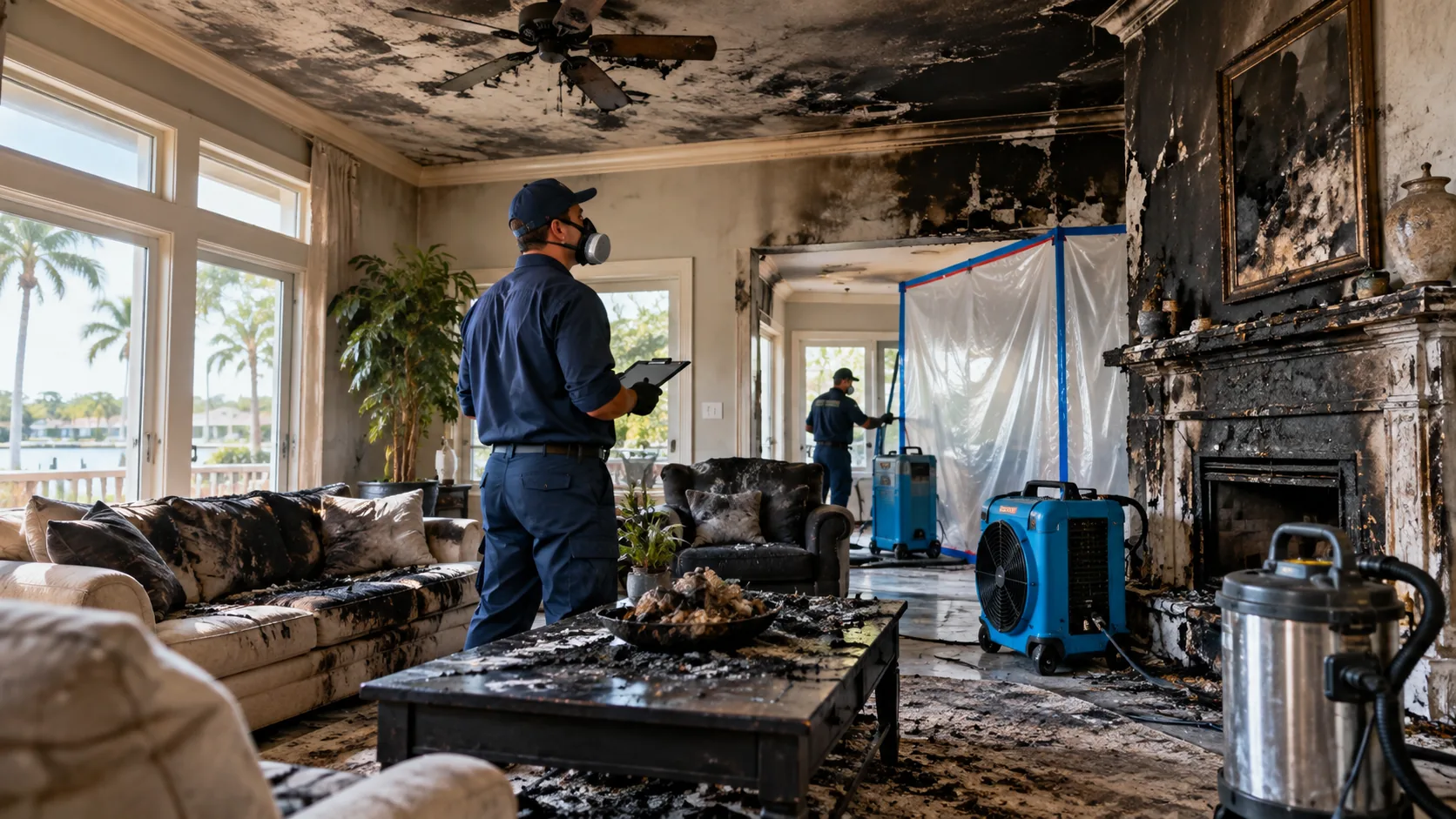
Fire damage is visible and localized. Smoke damage is invisible and everywhere. During a fire, superheated gases carry soot particles, vaporized plastics, and combustion byproducts throughout the building — through HVAC ductwork, under doors, into closets and wall cavities. It's common for rooms untouched by flame to have significant smoke odor and fine soot film on every surface.
Different fires produce different residues, and the cleanup method depends on the type. Protein fires from kitchen cooking leave a nearly invisible but intensely odorous residue. Synthetic materials produce a sticky, smeary soot that stains on contact. Wood and paper fires leave a dry, powdery ash that's easier to remove. Using the wrong method — especially water-based cleaning on the wrong residue type — can set stains permanently, which is why professionals test before they clean.
- HVAC systems distribute smoke to every room and usually need professional duct cleaning after a fire.
- Soft goods (upholstery, drapes, clothing) absorb odor deeply and often need specialized deodorization, not just washing.
- Attics and wall voids collect soot that keeps releasing odor for months if not addressed.
What happens to your belongings during fire restoration
Contents handling follows a deliberate sequence. First, items are inventoried and photographed room by room — this documentation protects you and supports the insurance claim. Then salvageable items are packed out to a controlled facility, where they're cleaned using methods matched to the material: ultrasonic cleaning for hard non-porous items, specialized washing for textiles, and ozone or hydroxyl treatment for odor.
Not everything can be saved. Items with melted components, severe charring, or heavy contamination are documented and discarded with your approval. Food in opened containers, medicines, and cosmetics exposed to heat or smoke should always be discarded — heat can compromise seals and safety even when packaging looks intact. Electronics need professional evaluation before being powered on, since soot is conductive and corrosive.
For a deeper look, read what happens to contents after a fire and fire, smoke, and soot damage explained.
What should I do after a fire?
Follow fire-department instructions, avoid unsafe areas, document visible conditions from a safe position and arrange an assessment of smoke, soot, water and contents impacts.
Why does smoke odor remain after visible soot is cleaned?
Smoke residues can affect porous materials and concealed areas. Odor control may require source removal and careful cleaning rather than fragrance alone.
Can firefighting water become part of a fire loss?
Yes. A fire event may leave both fire/smoke damage and water-related property impacts that need to be evaluated separately.
Can smoke-damaged belongings be saved?
Often yes — hard goods, textiles, electronics, and documents each have professional restoration methods. Don't discard items before they're inventoried for your claim; many things that look ruined are restorable. Our contents recovery guide details what can typically be saved.
How is smoke odor permanently removed?
Through chemical neutralization (hydroxyl generators or controlled ozone), thermal fogging that penetrates like smoke did, and sealing of porous materials where needed — not air fresheners. If odor persists after remediation, the scope was incomplete (often the HVAC was missed). See our odor removal information.
Is it safe to stay in a home after a fire?
Not until it's been assessed — structural integrity, air quality (soot particulates), and utilities all need verification. Even small fires can leave the building unsafe. Get professional clearance before spending significant time inside, and keep children and pets out until then.
How long does fire restoration take?
Small, contained fires: weeks. Major fires with structural damage: 3–6+ months including reconstruction. The contents pack-out, structural remediation, and rebuild phases run on overlapping timelines — your contractor should provide a written phased schedule.
Related guidance
Use the broader resource hub, service pages and local city pages to move from a question to a location-specific action plan.
Need to talk through a property loss?
Give the city, ZIP code and damage type when you call. For immediate life-safety emergencies, contact 911 first.