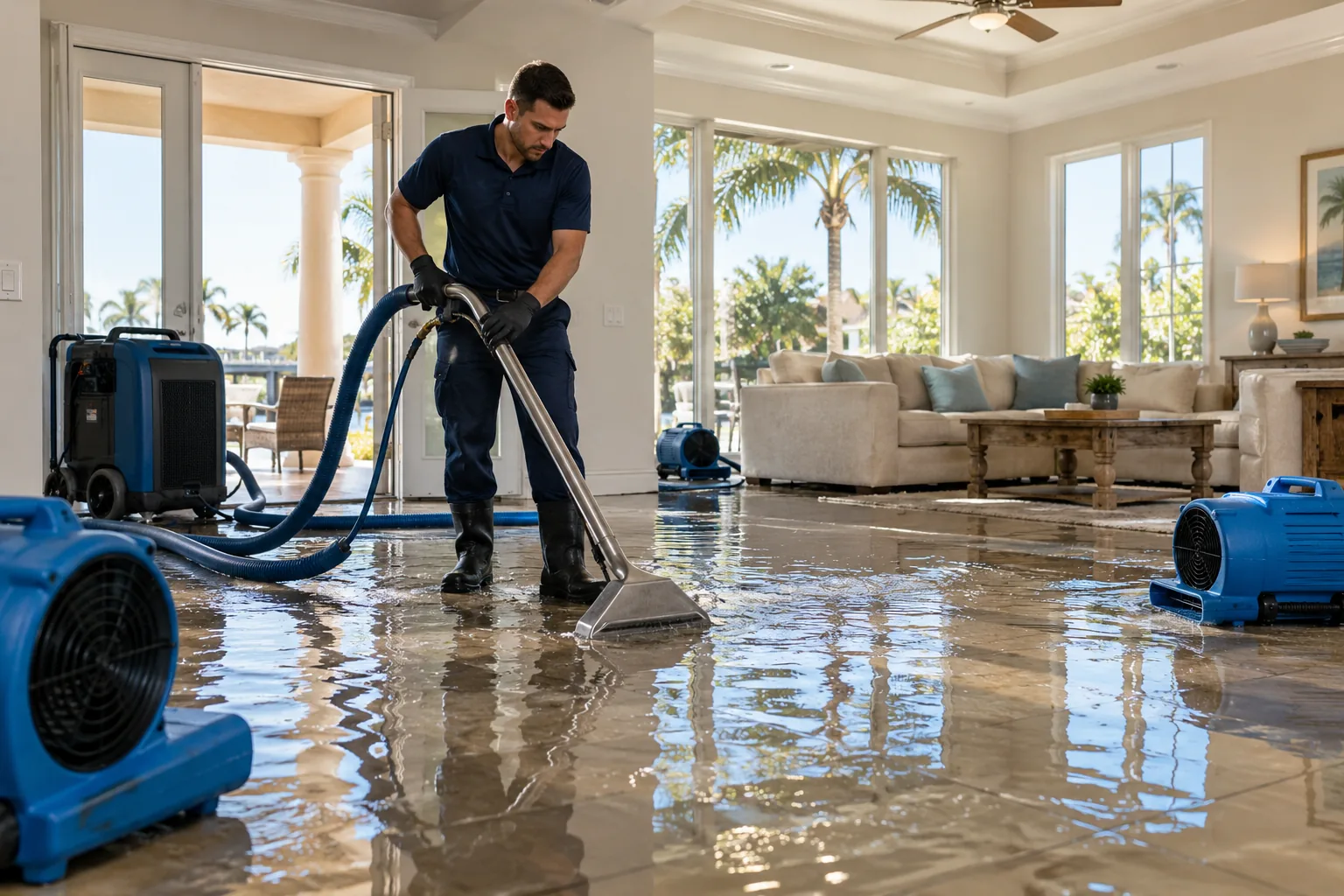
When water hits a commercial property, the math changes. A homeowner worries about their kitchen; a business owner watches revenue evaporate by the hour, tenants call with demands, and the lease says things about "casualty" that suddenly matter enormously. Commercial water response is its own discipline — here's how it works.
What should a business do first when water damage hits?
The short answer: Ensure occupant safety, stop the water source, protect revenue-critical assets (move or cover inventory, elevate electronics, secure records), document everything, and call your restoration vendor and insurer in parallel — not in sequence.
The instinct is to start cleaning. Resist it for ten minutes and triage instead: Is anyone in danger (electrical, structural, contamination)? What's the highest-value thing water is currently destroying? In an office, that's the server room; in retail, it's inventory; in a restaurant, it's the kitchen. Assign someone to each: one person on safety/utilities, one on asset protection, one on documentation. Then call for help. A pre-written one-page emergency plan — who calls whom, where the shutoffs are — turns chaos into procedure. If you manage properties, our commercial property management FAQs cover the ongoing responsibilities.
How is commercial water restoration different from residential?
The short answer: Scale, systems, and stakeholders. Commercial spaces are larger (requiring industrial desiccant dehumidifiers and staged drying zones), have complex systems (elevators, commercial HVAC, fire suppression), and involve multiple parties (owner, tenants, property manager, insurer) whose interests don't automatically align.
- Scale: A 20,000 sq ft office needs dozens of air movers and large desiccant units, plus containment zoning so unaffected areas stay operational. Drying is phased by zone, not done all at once.
- Systems: Water in elevator shafts, electrical rooms, or commercial kitchens triggers code and safety requirements that don't exist in homes. Elevators especially — water and elevator pits are a dangerous, expensive combination.
- Stakeholders: Tenants want immediate restoration; owners want cost control; insurers want documentation. The restoration plan has to satisfy all three, which is why commercial jobs need more formal scoping and communication.
- Continuity: The goal is often partial occupancy during restoration — drying Zone A while Zone B operates. This requires careful containment and scheduling.
Who pays for commercial water damage — owner or tenant?
The short answer: The lease decides. Most commercial leases split responsibilities: landlords typically handle structural/building systems (roof, plumbing mains, HVAC), tenants handle their contents, improvements, and business interruption — but triple-net, gross, and modified leases vary enormously. Read your casualty, maintenance, and insurance clauses before there's water on the floor.
The disputes that get expensive are the gray areas: a roof leak (landlord's roof) damages tenant improvements (tenant's property) and forces closure (tenant's lost income). Whose insurance covers what? The answer is in the lease's insurance requirements section — which is why sophisticated tenants and landlords align their coverage before signing. If you're in a dispute now, document everything and get coverage counsel involved early; the restoration itself shouldn't wait for the legal question to resolve. Our condo/HOA guide covers similar split-responsibility dynamics for associations.
How do you minimize business downtime during restoration?
The short answer: Zone the work so unaffected areas keep operating, schedule noisy/dusty demolition outside business hours, prioritize revenue-critical spaces first, set up temporary workarounds (temporary power, portable AC), and communicate the timeline to staff and customers proactively.
The most effective downtime reducer is a pre-existing relationship with a restoration company. When the vendor already knows your building — shutoff locations, sensitive areas, key contacts — mobilization takes hours instead of days. That's the core argument for pre-vetting: the cheapest time to choose a contractor is before you need one. After an event, also consider: can staff work remotely for three days? Can you relocate one department instead of closing entirely? Can the contractor work nights? Every day of partial operation beats a day of full closure. For the financial side of unexpected restoration costs, see our financing guide.
What should be in a commercial property emergency plan?
The short answer: A one-to-two page document with: emergency contacts (restoration vendor, plumber, electrician, insurer), shutoff locations with photos, floor plans marking sensitive areas, tenant notification procedures, and a basic communication template. Review it annually and after any building change.
The plan doesn't need to be elaborate — it needs to exist and be findable at 2 AM. The most valuable single page is a marked-up floor plan showing water shutoffs, electrical panels, server rooms, and areas with special contents. Tape a copy inside the electrical room and email one to your property manager. Properties with plans recover faster, document better, and argue less — because decisions were made calmly in advance, not frantically mid-crisis.
Dealing with this right now?
You don't have to figure out the next step alone. Call and describe what you see — where the damage is, how long it's been there, and whether it's still spreading — and you'll get a straight answer about what to do next.
Call (833) 606-6010 Request help online
emergency line. If there's an active life-safety danger, call 911 first. Email: help@skyfoldrestorationfl.com
Frequently asked questions
How fast should a commercial property respond to water damage?
Immediately — the same mold clock applies, but the financial clock ticks faster. Every hour of closure or degraded operation has a measurable cost. Pre-vetted vendors should be mobilizing within hours, not days.
Can part of the building stay open during restoration?
Often yes, with proper containment, zoning, and scheduling. Clean-water events in one zone can proceed while adjacent zones operate normally. Contamination events (sewage, extensive mold) may require broader closure — your contractor should explain the options with their trade-offs.
Does business interruption insurance cover water damage closures?
If you carry it and the cause is a covered peril, generally yes — it covers lost income and extra expenses during restoration. Document the closure timeline, lost revenue, and extra costs meticulously; these claims are calculation-heavy and live on records.
What about tenant belongings in a flooded commercial space?
Typically the tenant's responsibility under their own contents/business property coverage — another reason leases should require tenants to carry it. Coordinate access for tenants to retrieve or document their property, but establish clear boundaries about who's handling what.
How do I choose a commercial restoration vendor in advance?
Look for: commercial-scale equipment (ask what their largest desiccant is), experience with your building type, dispatch with a real person, documentation practices (moisture logs, photo reports), and references from other commercial clients. Get the agreement and pricing structure in place before the emergency.
Are there extra code requirements for commercial water restoration in Florida?
Commercial buildings face stricter requirements around electrical, fire suppression, elevators, and accessibility during repairs. Permits are more consistently required than in residential work. Your contractor should be familiar with commercial code compliance — verify this during vetting, not after demolition starts.